

Quick Answer:
CV (Curriculum Vitae): A detailed, multi-page document covering your full academic and professional history. Standard for government, academic, NGO, and research roles in Bangladesh.
Resume: A concise 1 to 2-page document tailored for a specific job. The preferred format across Bangladesh’s private sector, MNCs, banks, and tech companies.
Bio-Data: A personal information sheet that includes family background, religion, and physical details. Used for entry-level government jobs and matrimonial purposes across Bangladesh.
You’ve spent hours on your application, but sent the wrong document entirely. In Bangladesh, mixing up a CV, resume, or bio-data is one of the most common reasons candidates get filtered out before anyone reads a single line.
If you’re searching for jobs in Bangladesh and want your application to land, knowing which documents to send is where it starts.
What is a CV, Resume, and Bio-Data?
A CV (Curriculum Vitae) is a full record of your academic and professional life.
It covers your education from SSC onward, every job you’ve held, training you’ve completed, and any research or publications. Government institutions, public universities, and NGOs in Bangladesh use CVs because they need to see the full picture: not just a curated highlight.
Example of a resume:
A resume is a short, focused document, typically one to two pages, built for a specific job.
It cuts everything that isn’t directly relevant and puts your most valuable skills and achievements front and centre. Bangladesh’s private sector runs on resumes, from banks to tech startups to RMG companies
Example of a resume:
Bio-data is a South Asian document format that blends personal and professional information.
It includes your religion, parents’ names, marital status, and sometimes physical details alongside your qualifications. In Bangladesh, bio-data is used for entry-level government roles, clerical positions, and matrimonial purposes, making it genuinely useful in contexts where a CV or resume simply wouldn’t fit.
CV vs Resume vs Bio-Data: Key Differences at a Glance
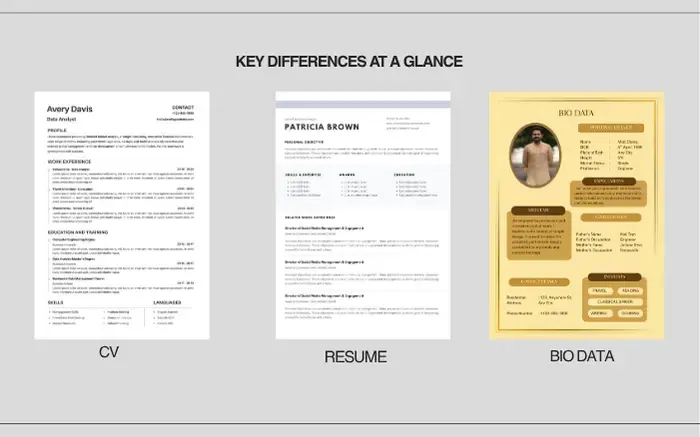
The table below covers what matters most for Bangladeshi job seekers, including the ATS question that most guides skip entirely.
| Feature | CV | Resume | Bio-Data |
| Full Name | Curriculum Vitae | Resume | Biographical Data |
| Purpose | Complete academic and professional record | Targeted job application document | Personal and professional overview |
| Length | 2–5+ pages | 1–2 pages | 1–2 pages |
| Content Focus | Education, research, full work history | Relevant skills, achievements, experience | Personal details, basic qualifications |
| Personal Info Included | Minimal | Minimal | Extensive: religion, family, photo |
| Customisation | Rarely customised per role | Tailored per job application | Rarely customised |
| Used in Bangladesh For | Government, academic, NGO, INGO, research | Private sector, MNCs, banking, tech, RMG | Entry-level govt jobs, matrimonial purposes |
| Who Should Use It | Academics, BCS applicants, NGO professionals | Corporate job seekers, private sector freshers | Entry-level applicants, matrimonial candidates |
| ATS Compatible? | Partially: only if formatted simply | Yes: highly compatible when properly formatted | No: personal data fields are not ATS-readable |
Good to Know: ATS stands for Applicant Tracking System: software that scans your document before a human ever sees it. We’ll cover this in detail under the resume section because it is directly affecting applications right now.
What is a CV, and when is it used in Bangladesh?
A CV is your complete professional story on paper.
In Bangladesh, submitting a CV signals that you are applying for a role where your full academic and institutional background matters: not just your last job title.
Government institutions, universities, and development organisations use CVs because they evaluate candidates on the depth of their qualifications, not a two-paragraph skills summary.
What Does a CV Include?
A strong Bangladeshi CV typically contains these sections:
- Full name, contact details, and a professional photo (optional but common)
- Career objective or personal statement: 2–3 sentences
- Educational qualifications from SSC through postgraduate, in reverse chronological order, with institution names, boards or universities, years, and grades
- Work experience: all positions held, with responsibilities described using action verbs
- Research experience and publications (for academic and scientific roles)
- Training, certifications, and workshops attended
- Computer skills and language proficiency
- Awards, scholarships, and academic honours
- Professional memberships and affiliations
- References: usually two, with full contact details (one professional, one academic)
Which Jobs in Bangladesh Require a CV?
Government and semi-government positions in Bangladesh almost universally require a CV. This includes:
- Bangladesh Civil Service (BCS) applications
- Public universities such as Dhaka University, BUET, and Rajshahi University
- Development organisations like BRAC, Grameen Bank, and CARE Bangladesh
- International NGOs including UNDP, WHO, Save the Children, and Oxfam
- Research institutes and public hospitals
- Government banks such as Sonali Bank and Janata Bank
These institutions evaluate candidates based on the depth of academic records, training history, and institutional affiliations.
A two-paragraph skills summary does not serve that purpose. If you’re applying for government jobs in Bangladesh, build a thorough CV before you submit anything.
What Should You Leave Out of a CV?
One of the most overlooked questions Bangladeshi job seekers have is not what to include, but what to cut. A bloated CV full of irrelevant content weakens your application.
| Include | Avoid |
| All verified academic qualifications | Fake or exaggerated certificates |
| Relevant training and workshops | School-level extracurriculars (after 5+ years of work experience) |
| Publications and research (if applicable) | Hobbies unrelated to the role |
| Professional references (with permission) | References listed without the person’s knowledge |
| Accurate employment dates | Unexplained employment gaps |
| Professional photograph if requested | Casual, informal, or low-quality photos |
| Specific achievements with measurable results | Vague phrases like “hardworking” or “good team player” |
| NID-matching name spelling | Name inconsistencies between documents |
Pro Tip: Your name must match your NID exactly across every document you submit. Inconsistencies between your CV, certificates, and NID create red flags during verification, especially for government roles.
What is a Resume and When is it Used in Bangladesh?
The resume is the document of Bangladesh’s modern job market. Unlike a CV, it is not an archive: it is a targeted pitch.
Every line on a resume should answer one question: Why should this employer hire me for this specific role?
What Does a Resume Include?
- Full name, phone number, email address, and LinkedIn profile or portfolio link
- Professional summary: 2–3 lines that sell your top value to the employer
- Key skills: 6–8 bullet points of hard and soft skills relevant to the role
- Work experience in reverse chronological order, with bullet-point achievements rather than duty lists
- Education: most recent degree first, kept concise
- Certifications and relevant short courses
- Optional sections: projects, volunteer work, publications: only if genuinely relevant to the target role
Why Do Bangladesh’s Corporate Sectors Prefer a Resume?
Bangladesh’s private sector is fast-paced, and hiring managers at major companies receive hundreds of applications per role.
RMG companies like Beximco and Square Group, private banks like BRAC Bank and Dutch-Bangla Bank, MNCs such as Unilever Bangladesh, Nestlé Bangladesh, and British American Tobacco, and the growing tech and e-commerce sector all lean heavily on resumes during recruitment.
These organisations need to screen applicants quickly.
A one-to-two-page resume that maps directly to the job description lets HR teams identify qualified candidates in minutes. A five-page CV sent to a corporate recruiter managing 300 applications for a marketing role is not an asset: it creates friction and often gets skipped.
nextjobz has processed thousands of job applications across Bangladesh’s private sector, and the pattern is consistent: targeted resumes move forward; comprehensive CVs sent to the wrong employer do not.
Is a Resume ATS-Compatible in Bangladesh?
This is the question most Bangladeshi job seekers are not asking, and it is costing them interviews.
A growing number of large corporations and multinational companies operating in Bangladesh use Applicant Tracking Systems (ATS) to filter resumes before a human recruiter ever sees them.
The software scans your document for keywords, structure, and formatting, and automatically rejects submissions that fail its criteria.
To make your resume ATS-friendly, follow these steps:
- Use standard section headings like “Work Experience” and “Education” : not creative alternatives
- Avoid tables, text boxes, columns, graphics, and icons in the layout
- Pull keywords directly from the job description and use them throughout your resume
- Submit in PDF or .docx format unless the employer specifies otherwise
- Stick to clean, single-column layouts with readable fonts like Calibri, Arial, or Georgia
- For banking roles, include terms like “credit risk assessment,” “regulatory compliance,” and “core banking solutions.”
- For RMG roles, use terms like “quality control,” “BGMEA compliance,” “production planning,” and “lean manufacturing.”
Warning: Decorative resume templates with columns, icons, and coloured sidebars look impressive to the human eye but often fail ATS scans completely. A plain, well-structured resume beats a fancy one every time in Bangladesh’s corporate hiring process.
What is Bio-Data, and when is it used in Bangladesh?
Bio-data is a document that feels distinctly South Asian: because it is.
Where a CV or resume strips personal identity down to professional credentials, bio-data leans into it. It reflects a cultural context where knowing who a person is: their family background, their religious identity, their community ties, is considered relevant information, both in employment and in social life.
What Does a Bio-Data Include?
- Full name and parents’ names (father’s and mother’s names)
- Date of birth and age
- Nationality and religion
- Marital status
- Permanent and present address
- Educational qualifications
- Work experience: brief overview
- Computer and language skills
- Family information: number of siblings, parents’ occupation
- References (one or two)
- Passport-size photograph
Matrimonial Bio-Data vs Job Bio-Data: What is the Difference?
Bio-data serves two very different purposes in Bangladesh, and the format changes significantly depending on whether it is for a job or a marriage proposal.
| Feature | Matrimonial Bio-Data | Job Bio-Data |
| Primary Purpose | Finding a life partner | Entry-level or local job applications |
| Physical Details | Extensively included : height, weight, complexion | Usually omitted |
| Family Background | Core section : parents, siblings, social and economic status | Brief or omitted |
| Financial Information | Sometimes included : property, income | Not included |
| Religion and Sect | Always included | Commonly included in Bangladesh context |
| Hobbies and Interests | Frequently included | Rarely included |
| Photo | Almost always required | Often required |
| Education and Work | Brief overview | More detailed |
| Tone | Personal and family-centred | Slightly more professional |
Is Bio-Data Still Accepted for Government Jobs in Bangladesh?
Yes, bio-data remains relevant in specific corners of Bangladesh’s public sector.
For BCS applications, the official Bangladesh Public Service Commission (BPSC) application form captures comprehensive personal, family, and academic data that mirrors the bio-data format.
At the local government level, offices including upazilas, union parishads, and district administration still use bio-data as standard for clerical, support, and entry-level administrative roles.
Smaller government-linked organisations and NGOs operating outside major cities also regularly accept bio-data, particularly for SSC or HSC pass candidates applying for non-specialised positions.
Which Document Should You Submit: and When?
This is the most practical question, and the one most guides fail to answer with enough specificity for the Bangladeshi context.
| Scenario | Recommended Document | Why |
| Fresh graduate applying for a private sector job | Resume | Concise, skill-focused, preferred by corporate HR and ATS-compatible |
| Experienced professional applying for a corporate role | Resume | Targeted, fast to screen, maps to job description |
| Applying for BCS or a government job | CV | Government institutions require a comprehensive academic and professional history |
| Applying to an NGO or INGO | CV | The development sector evaluates the depth of experience, training, and qualifications |
| Matrimonial purposes | Bio-Data | Families and matchmakers expect personal, family, and physical information |
| Applying for an international corporate job from Bangladesh | Resume | Global private sector hiring is resume-driven |
| Applying for an international academic or research role | CV | Universities and research institutions globally require full qualification records |
| Applying for an academic position in Bangladesh | CV | Public and private universities expect complete academic credentials |
Action Item: Before you write a single word, check the job posting carefully. Government roles will almost always state “CV required” or link to an official BPSC form.
Private sector postings almost never ask for a full CV: they want a resume, even if they use the word “CV” loosely in everyday conversation.
What Does Each Document Look Like?
The structure of your document matters as much as the content inside it.
A CV, resume, and bio-data each follow a different format, and sending one with the wrong layout signals to the employer that you don’t understand the role you’re applying for. Here is what each one should look like.
Ideal Structure of a CV
- Personal Information: Name matching your NID, contact details, nationality, and optional photo
- Career Objective: 2–3 sentences summarising your professional direction
- Educational Qualifications: All degrees in reverse chronological order with institutions, boards or universities, years, and grades
- Work Experience: All positions with responsibilities written using action verbs
- Research and Publications: Academic papers, theses, journals (for research or academic CVs)
- Training and Certifications: Workshops, short courses, professional development
- Skills: Language proficiency (Bangla, English, others), computer skills, technical competencies
- Awards and Scholarships: Academic distinctions, merit scholarships, competitive honours
- Professional Memberships: Industry associations, professional bodies
- References: Two referees with titles, organisations, and full contact information
Ideal Structure of a Resume
- Header: Name, phone number, email, LinkedIn or portfolio link
- Professional Summary: 2–3 lines that immediately communicate your value to the employer
- Key Skills: 6–8 bullet points of hard and soft skills aligned to the target role
- Work Experience: Reverse chronological list with bullet-point achievements, not duty lists
- Education: Your degree, institution, and year. Keep it brief and clean.
- Certifications: Only relevant, verifiable credentials
- Optional Sections: Projects, publications, volunteer experience: only if relevant to the role
Want to know how to make your resume stand out before it even reaches a recruiter? Read our guide on how to get your CV shortlisted.
Ideal Structure of a Bio-Data
For Job Purposes:
- Personal Details: Name, father’s name, date of birth, religion, nationality, marital status
- Contact Information: Present and permanent address, phone, email
- Educational Qualifications: SSC through the highest degree, with institutions and years
- Work Experience: Job titles, organisations, and duration
- Skills: Computer literacy, language proficiency
- References: Two professional or academic contacts
- Photograph: Passport-size, formal attire
For Matrimonial Purposes:
- Personal Details: Full name, date of birth, height, weight, complexion, religion, sect
- Family Background: Parents, siblings, family’s social and economic status, home district
- Education and Professional Background: Degrees held and current role
- Financial Information: Current income, property (optional but common)
- Partner Expectations: Qualities sought (optional)
- Contact Information: Guardian’s phone number (not always the applicant’s directly)
- Photograph: Recent, formal, high-quality
Common Misconceptions Bangladeshi Job Seekers Have
| Myth | Fact |
| “CV and resume are the same thing.” | They are fundamentally different documents. A CV is a comprehensive multi-page record; a resume is a short, targeted pitch. Using the wrong one signals a lack of professional awareness. |
| “Bio-data is only for marriage.” | Bio-data is actively used for entry-level government roles, local NGO applications, clerical positions, and traditional sector hiring across Bangladesh. |
| “The longer your CV, the better.” | A longer CV only helps when the extra content is genuinely relevant. Irrelevant padding dilutes impact and frustrates hiring managers reviewing dozens of applications. |
| “You can send the same resume to every employer.” | With ATS in use at 75% of large Bangladesh employers, a generic resume frequently gets filtered out before a human reads it. Tailor your resume to each job description. |
| “Bio-data is outdated and never used anymore.” | Bio-data remains actively used in Bangladesh for matrimonial purposes, local government roles, entry-level positions outside Dhaka, and industries with traditional hiring cultures. |
| “A resume looks unprofessional because it leaves things out.” | A resume is not unprofessional: it is strategically focused. Corporate employers in Bangladesh and globally prefer brevity and relevance over exhaustive lists of every role you have ever held. |
Knowing which document to send is half the battle.
The other half is making sure it is written and formatted to the highest standard. Get started with free, professionally designed CV and resume templates built specifically for the Bangladesh job market at nextjobz.
Send the right document. Your next move starts there.
Frequently Asked Questions
Which document should a fresh graduate submit in Bangladesh?
A fresh graduate applying to a private company should submit a clean, one-page resume focused on education, skills, and internship or project experience. For government, NGO, or academic roles, a CV is more appropriate: listing full academic history, training attended, and any relevant research or project work.
Can I use the same CV for every job application?
For traditional CVs used in government or academic applications, minor adjustments are acceptable. For resumes sent to private sector employers, tailor your professional summary and skills section to the language and requirements of each specific job description, especially given ATS filtering across Bangladesh’s corporate sector.
Which document is required for BCS or government jobs in Bangladesh?
Government and BCS-related applications require a CV. The Bangladesh Public Service Commission (BPSC) application process requires comprehensive personal, academic, and professional information aligned with the CV format. All original or provisional academic certificates must also be submitted before the viva-voce stage.
What is the ideal length of a CV in Bangladesh?
A recent graduate or early-career professional should aim for 2–3 pages. Mid-career professionals with 5–10 years of experience should aim for 3–4 pages. Senior academics, researchers, or professionals with extensive publications and leadership roles may have CVs of 5 pages or more. Never add content solely to increase length: every section should earn its place.
Final Recommendation: Which One Should You Use?
The right document depends entirely on where you are applying and what that employer expects from you. Bangladesh’s job market runs on three parallel systems, and knowing which one applies to your situation is the first step toward a stronger application.
If you are targeting private companies, banks, MNCs, tech startups, or e-commerce businesses, write a sharp, ATS-optimised resume tailored to each specific role.
If you are applying for a BCS position, a public university role, a government bank job, or an NGO or INGO position, invest the time in building a thorough CV that documents your complete academic and professional record.
And if you are applying for an entry-level local government or clerical role, or preparing a matrimonial profile, a well-structured bio-data remains entirely appropriate and widely accepted across Bangladesh.