
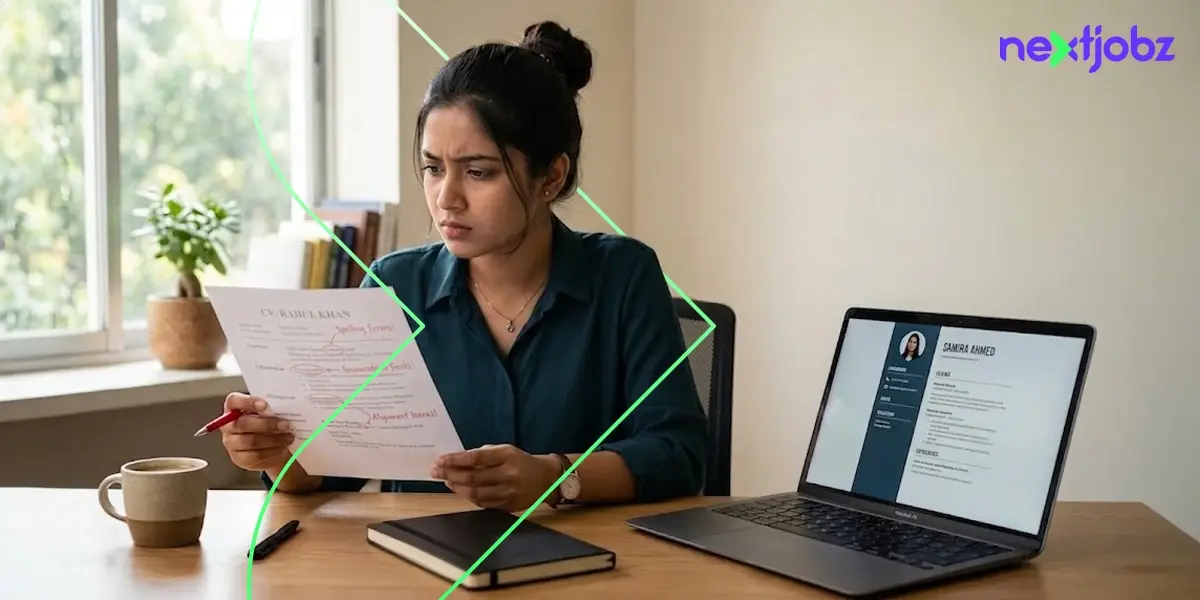
Your CV might be costing you interviews before a single recruiter ever reads your name. The truth is, common CV mistakes are one of the biggest reasons job seekers fail to secure interviews in 2026.
Spelling errors, weak formatting, generic templates, job duties instead of achievements, these aren’t minor slip-ups. They’re deal-breakers.
Recruiters spend just 6–7 seconds on an initial scan, and up to 75% of applications never even reach a human desk due to poor formatting and missing keywords.
At nextjobz, we’ve broken down every major CV mistake and exactly how to fix each one, so your application works for both the algorithm and the person making the final call.
Key Takeaways
| Mistake | Why It Costs You | Quick Fix |
| Spelling and grammar errors | 77% of hiring managers auto-reject typos | Read backwards, print it out, get peer review |
| Generic CV | 36% of CVs rejected for being too generic | Mirror keywords from each job description |
| No ATS optimisation | 43% of ATS rejections are formatting failures | Single column, standard fonts, no tables or text boxes |
| Duties instead of achievements | Recruiters already know the job exists | Action verb + task + quantified result |
| Buzzwords without evidence | Recruiters are desensitised to “hard-working.” | Replace adjectives with numbers and outcomes |
| Poor formatting and layout | Canva templates break ATS parsing | Arial or Calibri, 1-column, .docx format |
| Wrong CV length | Too long signals poor editing | 1 page for grads, 1–2 for mid-career, 2–3 for seniors |
| Bad contact info | ATS cannot read headers or footers | Professional email, phone, city: in the body |
| Irrelevant personal info | Creates legal risk, wastes space | Skills and experience only |
| Unexplained gaps | Recruiter speculation fills the blank space | Frame the gap with honest context and evidence |
| Lying or exaggerating | 75% of HR managers have caught a CV lie | Only claim what you can defend in an interview |
| LinkedIn inconsistency | Mismatched dates create instant doubt | Audit your LinkedIn every time you update your CV |
| Over-relying on AI | Recruiters now recognise the pattern | Write your story, use AI to sharpen it |
1. Spelling and Grammar Errors
One typo can undo everything. Here’s why recruiters notice instantly, and how to make sure yours is clean.
Why recruiters reject CVs instantly for typos
A typo is never “just a typo” to a hiring manager.
It signals carelessness: and if you cannot proofread a two-page document submitted in your own name, why would an employer trust you with their clients, their data, or their brand?
According to employer surveys, 77% of hiring managers say spelling mistakes are an automatic deal-breaker, and the rejection happens in seconds.
The problem is compounded by familiarity bias: after reading your own CV dozens of times, your brain auto-corrects errors before your eyes register them.
How to fix it
Use a layered approach to proofreading. Never rely on a single method:
- Grammarly or similar tools: Catch grammar, punctuation, and tone issues automatically
- The read-backwards trick: Read each sentence from the bottom of the page upward; your brain cannot predict what comes next, so errors become visible
- Print and review: errors that are invisible on screen appear clearly on paper, as confirmed by professional recruiters
- Peer review: a fresh pair of eyes will always catch what yours have missed
Pro Tip: The read-backwards trick sounds odd, but it works. Your brain stops auto-filling what it expects to see and starts reading what is actually there.
2. Using a Generic, One-Size-Fits-All CV
Hiring managers review dozens, sometimes hundreds, of applications for a single role.
A generic CV that could have been sent to any employer in any industry signals one thing immediately: you are not that interested in this job.
Tailoring your CV is not optional in 2026; it is the baseline expectation for any competitive application.
The “master CV” method
Sending the same CV to every employer is one of the most damaging mistakes a job seeker can make.
Research shows 36% of CVs are rejected specifically for being too generic, while tailored CVs are up to 40% more likely to secure an interview.
Build a strong “master CV” containing every role, achievement, and skill you have developed, but never send it directly. Use it as a base to build a targeted version for each application, keeping only what is relevant and mirroring the language in the job description.
Stat Callout: Tailored CVs are up to 40% more likely to get an interview than generic ones.
How to mirror keywords from the job description
Modern ATS systems and hiring managers both respond to relevance.
If the job description says “stakeholder management,” your CV should contain that exact phrase: not a creative paraphrase.
Read the job posting, identify the five to ten most important skills and phrases, and weave them into your bullet points naturally, backed by evidence.
If the role requires “data-driven decision making,” write: “Used sales data analysis to identify a 22% drop in repeat customers, leading to a loyalty programme that recovered £140K in annual revenue”: not “analytical mindset.”
Best Practice: Build your master CV in a Google Doc. Each time you apply, duplicate it, strip what is not relevant, and replace generic phrases with the exact language in the job ad.
3. Ignoring ATS Optimisation
An Applicant Tracking System (ATS) is software used by most medium and large employers to manage applications.
When you submit your CV, the ATS parses it: extracting your name, contact details, work history, and skills, then scores your profile against job requirements.
Critically, 43% of ATS rejections have nothing to do with your qualifications. They result from formatting errors and parsing failures that prevent the system from reading your CV at all.
A highly qualified candidate can be completely invisible simply because of a table or text box.
We’ve helped thousands of job seekers in Bangladesh get shortlisted, and the pattern is consistent: a great candidate with a Canva CV gets filtered out before a human ever sees their name. Our guide on building an ATS-friendly CV for the Bangladeshi job market covers this in detail.
ATS formatting killers
These formatting choices cause CV parsing to fail:
- Tables and columns: ATS reads left-to-right across the full page, scrambling split-column layouts
- Text boxes: content inside text boxes is often invisible to ATS parsers
- Headers and footers: Many ATS systems cannot extract contact information from these zones
- Graphics, logos, or icons: decorative to a human, unreadable to a machine
- Unusual fonts: stick to Arial, Calibri, or Times New Roman at 10–12pt
ATS-safe file formats
Use .docx as your default unless the posting specifically requests a PDF. While modern ATS tools have improved PDF parsing, .docx files are more reliably read across all systems.
| ATS-Friendly Choice | ATS-Hostile Choice |
| Single column layout | Two or three column layout |
| Standard fonts (Arial, Calibri) | Decorative or custom fonts |
| Plain bullet points | Icons or graphic elements |
| Contact info in main body | Contact info in header/footer |
| .docx or standard PDF | Scanned image PDF |
| Keywords from job description | Creative paraphrasing of skills |
Warning: Canva and Figma CV templates look impressive on screen, but they almost always use multi-column layouts, text boxes, and embedded graphics: every formatting choice that causes ATS parsing to fail.
A beautifully designed CV that cannot be read by an ATS is worse than a plain document that can. Save creative design for your portfolio.
4. Listing Duties Instead of Achievements
The most common CV mistake across all industries is writing a job description rather than a performance record.
Recruiters already know what a marketing executive or software developer does day-to-day. What they want to know is: what changed because you were there?
Apply the “So what?” test to every bullet point.
If you write “Managed social media accounts,” ask yourself: So what? If the answer is “Grew follower count by 45% and increased leads by 63%,” that is your real bullet point. The first version gets ignored. The second gets you shortlisted.
Stat Callout: The “So what?” test is the single fastest way to transform a CV from forgettable to shortlist-worthy.
The formula: Action Verb + Task + Quantified Result
| Weak (Duty-Focused) | Strong (Achievement-Focused) |
| Managed social media accounts | Grew Instagram following from 12K to 17.4K (+45%) in 6 months, increasing engagement by 63% |
| Handled customer complaints | Reduced resolution time from 5 days to 2 days, lifting customer satisfaction score to 4.8/5 |
| Assisted with project planning | Coordinated 3 cross-functional projects ($500K budget), all delivered 2 weeks ahead of schedule |
| Trained new staff members | Designed an onboarding programme for 24 new hires, cutting average ramp-up time by 30% |
| Updated company database | Cleaned and restructured 5,000+ records, improving data accuracy from 87% to 98% |
Action Item: Go through your current CV now. Apply “So what?” to every bullet. If you cannot answer it with a number or outcome, rewrite the bullet.
5. Using Clichés and Buzzwords Without Evidence
Phrases like “hard-working,” “passionate,” “team player,” and “go-getter” appear on so many CVs that recruiters have become completely desensitised to them.
They communicate nothing because every candidate uses them, and they waste space that could contain real evidence of your value.
| Overused Buzzword | % of Recruiters Who Find It Off-Putting |
| “Synergy” | 72% |
| “Go-getter” | 71% |
| “Hard-working” | 68% |
| “Results-driven” | 67% |
| “Team player” | 64% |
| “Thought leader” | 63% |
| “Passionate” | 59% |
How to replace clichés with evidence-backed statements
The rule is simple: never state a quality; demonstrate it. Instead of “passionate about sales,” write: “Exceeded quarterly revenue targets by 28% for three consecutive quarters, securing 3 enterprise clients worth $250K annually.”
The evidence does the work. The adjective does not need to exist. If you are struggling with this, our resource on how to get your CV shortlisted has helped across industries.
6. Poor Formatting and Layout
Professional formatting is not about aesthetics: it is about readability and parseability.
Use a clean single-column layout with standard fonts, consistent spacing, and clear section headers:
- Font: Arial, Calibri, or Times New Roman, 10–12pt body text
- Margins: 1 to 1.5 inches on all sides
- Line spacing: 1 to 1.5 lines
- Section headers: bold, 12–14pt, consistent throughout
- Date formatting: consistent throughout (e.g., “Jan 2023 – Mar 2025” everywhere)
Why Canva and creative templates can get you auto-rejected
Canva and Figma CV templates look impressive on screen but almost always use multi-column layouts, text boxes, and embedded graphics: every formatting choice that causes ATS parsing to fail.
A beautifully designed CV that cannot be read by an ATS is worse than a plain document that can.
CV file naming: the overlooked professional detail
Most candidates save their CV as “CV.pdf” or “Resume_Final_v3.pdf”: unprofessional and difficult for recruiters managing hundreds of files to organise. Use a consistent professional format:
FirstName_LastName_Role.pdf
Example: Farhan_Ahmed_Marketing_Manager.pdf
This small detail signals professionalism and makes you instantly findable in a recruiter’s downloads folder.
Pro Tip: The file name is the first thing a recruiter sees before they even open your document. “Resume_Final_FINAL_v3.pdf” tells them a lot about how you work.
7. CV Length: Too Long or Too Short
A two-page CV is the gold standard for most working professionals. Going beyond that without senior-level justification suggests poor editing skills: a red flag in any role requiring written communication.
| Career Stage | Recommended Length | Key Focus |
| Graduate / Entry-level (0–3 years) | 1 page | Education, internships, projects, skills |
| Mid-career professional (3–15 years) | 1–2 pages | Achievements, progression, and relevant skills |
| Senior / Director level (15+ years) | 2–3 pages | Leadership impact, strategic results |
| Academic or Medical professional | 3+ pages if required | Publications, research, credentials |
The 10–15 year rule
Unless early career experience is directly relevant to your target role, limit your detailed work history to the last 10–15 years. Earlier roles can be listed briefly by title and employer, or omitted entirely if they add no value.
Good to Know: For fresh graduates exploring sales and marketing roles or government positions at nextjobz, a tightly edited one-page CV almost always outperforms a padded two-page version.
8. Missing, Incorrect, or Unprofessional Contact Information
Your contact section should sit at the top of the main body of your CV: never in a header or footer, because ATS systems frequently cannot extract information from those document zones. Include:
- Professional email: [email protected] (never nicknames or old university addresses)
- Phone number with country code if applying internationally (+880 for Bangladesh)
- City and country only: a full address is unnecessary and creates a privacy risk
- LinkedIn URL: only if your profile is complete and consistent with your CV
Do not include:
- Full street address
- Date of birth or age
- Marital or family status
- A photograph (in the UK, discouraged under the Equality Act 2010 due to anti-discrimination law)
- Personal social media handles, unless professionally relevant
Heads Up: If your contact information is in a header or footer, many ATS systems will not be able to read it at all. Your application will be processed with no way for the employer to reach you.
9. Including Irrelevant Personal Information and Oversharing
Including personal details such as age, religion, nationality, or marital status is unnecessary and creates risk for both candidate and employer.
In the UK, the Equality Act 2010 protects nine characteristics from discrimination, and responsible employers prefer applications that focus on skills and experience. The global professional norm is moving firmly toward skills-first applications: Bangladesh included.
Hobbies and interests: when to include them
Only include hobbies if they are genuinely relevant to the role or demonstrate clear transferable skills.
“Competitive debate” supports a communications application. “Team sports captain” reinforces a leadership narrative. Generic personal interests with no professional relevance waste valuable space.
References: what actually works in 2026
“References available on request” is outdated advice that wastes space.
Every employer assumes references are available. Either omit the section entirely, or list two to three professional references with their name, title, organisation, and contact details directly on the CV.
FYI: In Bangladesh, including a photo is acceptable and sometimes expected for corporate roles. For international applications to the UK or Europe, leave it out entirely.
10. Unexplained Employment Gaps
Gaps are common: caregiving, redundancy, health, travel, and further study are all legitimate reasons for time away from formal employment.
The mistake is leaving the gap blank, which forces the recruiter to speculate negatively. Frame gaps with context and evidence of productive activity:
“Career break (2023–2024): Primary caregiver for a family member. Maintained professional development through LinkedIn Learning certifications in project management and data analysis.”
The personal branding principle
Think of your career as a narrative, not just a list of jobs. Every role, gap, and transition should tell a coherent story about where you have been and where you are going. If you can articulate your journey confidently on paper, you will defend it confidently in an interview.
Remember: Recruiters do not penalise gaps: they penalise gaps with no explanation. A three-line honest account of a career break is far more compelling than silence.
CV Mistakes Checklist: Review Before You Submit
| Category | Check Before Submitting |
| Content | No typos or grammar errors: proofread multiple ways |
| All achievements quantified with numbers and outcomes | |
| CV tailored to this specific job description | |
| No unsupported clichés or generic buzzwords | |
| Employment gaps addressed with honest context | |
| No false or exaggerated information | |
| Format | Single column, simple font, ATS-safe layout |
| No tables, text boxes, columns, or graphics | |
| File saved as FirstName_LastName_Role.pdf | |
| Appropriate length for your career stage | |
| File format matches job application instructions | |
| Contact | Professional email address included |
| Phone number with correct country code | |
| City and country listed (not full home address) | |
| LinkedIn URL included and fully up-to-date | |
| Contact information NOT in header or footer | |
| Quality | LinkedIn dates, titles, and skills match the CV exactly |
| Reviewed by at least one other person | |
| Printed and reviewed on paper, not just on screen |
Your CV is not a document about your past. It is an argument for your future. Fix the mistakes, speak to the right systems and the right humans, and the shortlist takes care of itself.
Frequently Asked Questions About CV Mistakes
How do I make my CV ATS-friendly in 2026?
Use a single-column layout with standard fonts such as Arial or Calibri. Include keywords taken directly from the job description. Avoid tables, graphics, text boxes, and headers or footers. Save as .docx unless the application specifies otherwise.
How long should a CV be in 2026?
For most professionals, one to two pages is the standard. Entry-level candidates should target one page. Mid-career professionals should use one to two pages. Senior executives may extend to two to three pages, covering the last 10–15 years of experience.
Should I include a photo on my CV?
In Bangladesh, a professional passport-style photo is acceptable and sometimes expected for corporate roles. For international applications to the UK or Europe, do not include a photo : the UK Equality Act 2010 discourages it as part of anti-discrimination employment practice. Always check the specific requirements of the employer and region.
What should you never put on a CV?
Never include your full home address, date of birth, marital status, religion, nationality, or age. Avoid unsupported buzzwords, protected personal characteristics, unverified skills, and roles or qualifications you cannot defend in an interview.
How often should I update my CV?
Update your CV every three to six months, or immediately after a major achievement, promotion, new responsibility, or completed certification. Maintain a comprehensive master CV and tailor it specifically for every application: never send the master version directly.