
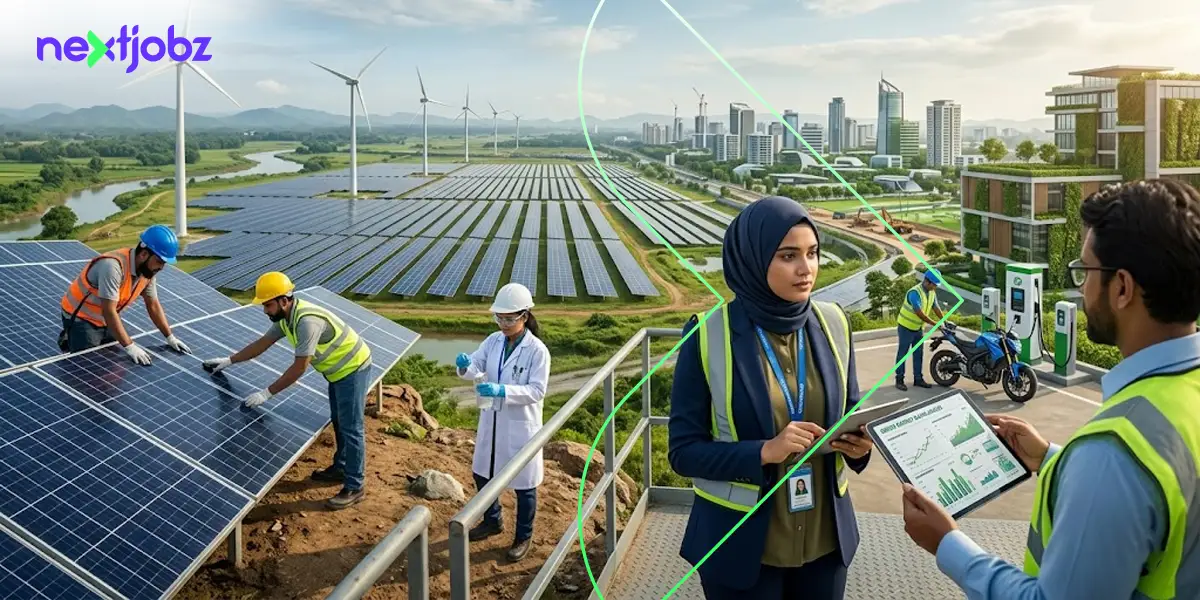
A renewable energy career means working professionally in industries that produce, finance, install, or regulate clean power, including solar, wind, hydro, and battery storage.
The sector spans engineering, finance, policy, and trades, with global employment at 16.6 million in 2024 and Bangladesh expecting over 9,300 new skilled jobs by 2030.
High-Demand Career Paths
- Engineering and Technical: Designing, installing, and managing solar, wind, and storage systems
- Project and Finance: Delivering infrastructure projects and structuring green investment deals
- Policy and Advisory: Navigating regulation, EIA, and development frameworks at SREDA and beyond
- Installation and Trades: Site-based technicians and field agents across solar deployment programmes
Qualifications and Skills
Technical roles suit engineering graduates from BUET, KUET, or RUET, while trades entry flows through BTEB diplomas and BRTC programmes. Across every track, employers prioritise problem-solving, data literacy, and cross-functional communication.
How to Get Started
Identify your track, build one focused credential such as NABCEP, PMP, or CEM, then search verified listings on nextjobz.com.bd.
Key Takeaways
- Renewable energy employed 16.6 million people globally in 2024, with projections exceeding 30 million jobs by 2030
- You do not need an engineering degree; finance, policy, IT, and sales professionals are all actively recruited
- Entry-level salaries start at $50,000–$80,000 USD globally; in Bangladesh, BDT 40,000–80,000/month for entry-level positions
- Bangladesh expects over 9,300 new skilled renewable energy jobs by 2030, driven by solar expansion, offshore wind, and grid investment
- Career paths split across four tracks: technical/engineering, business/finance, policy/advisory, and trades/installation
What Is a Renewable Energy Career?
A renewable energy career means working professionally in industries that produce, finance, regulate, install, or analyse clean power, including solar, wind, hydro, biomass, geothermal, and battery storage.
These roles span engineering, finance, policy, data, trades, sales, and research across public, private, and development sectors.
The sector is far broader than most people realise.
Engineers design and build systems, but an equally large workforce manages projects, secures financing, drafts regulations, and monitors performance data. Almost every professional background has a genuine entry point here, not just a consolation route.
Why Renewable Energy Careers Are Booming Right Now
Renewable energy employed 16.6 million people globally in 2024, up from 7.3 million in 2012.
According to the IEA’s clean-energy outlook, that number could exceed 30 million by 2030 as net-zero commitments drive investment into solar, storage, grids, and EV supply chains.
The growth in Bangladesh is just as sharp. The skilled renewable energy workforce is projected to grow from 4,472 to 13,778 jobs by 2030, a net gain of over 9,300 positions.
Clean energy investment is now outpacing fossil fuel spending. Every project funded creates demand for engineers, analysts, advisors, and operators.
Understanding the Sector: The Four-Track Value Chain
The renewable energy industry is not one career path. It is an ecosystem with distinct layers, each employing thousands of professionals across different disciplines.
Knowing which track suits your background saves months of unfocused effort.
| Track | What It Covers | Who It Suits |
| Track A – Technical Core | R&D, manufacturing, installation, grid operations | Engineers, technicians, tradespeople |
| Track B – Finance & Investment | Project finance, VC, PE, development banks, green bonds | Finance, economics, MBA graduates |
| Track C – Policy & Advisory | Government bodies, regulation, NGOs, industry associations | Policy, law, social science graduates |
| Track D – Consulting & Research | Market analysis, technical due diligence, strategy | Analysts, researchers, generalists |
Who Can Work in Renewable Energy? (You Do Not Need an Engineering Degree)
The renewable energy sector is one of the most professionally diverse industries in the world. If any of the following describe you, you already have transferable value:
- Finance or economics graduates: project finance, investment analysis, green bonds, ESG reporting
- Business or MBA professionals: development, procurement, commercial management, corporate strategy
- IT and data professionals: performance monitoring, SCADA systems, GIS mapping, AI-assisted modelling
- Logistics and operations managers: supply chain coordination, procurement, site logistics
- Policy, law, or social science graduates: regulatory affairs, government advisory, stakeholder engagement, EIA
- Teachers and communications professionals: workforce training, outreach, sustainability communications, public affairs
Career Transition Map: Your Background to Your Best Entry Role
Most professionals already have 60–70% of what a renewable energy employer needs.
The gap is usually one certification and the ability to frame your existing experience in sector language. Use this table to find your fastest route in.
| Your Background | Best Entry Track | Target Job Title | Key Credential to Add |
| IT / Software | Track D / A | Energy Data Analyst, SCADA Engineer | GIS certification, Python for energy |
| Finance / Accounting | Track B | Project Finance Analyst, ESG Analyst | CFA, project finance course |
| Teaching / Training | Track C / D | Sustainability Trainer, Outreach Officer | LEED Green Associate |
| Military / Logistics | Track A / B | Project Coordinator, Site Manager | PMP certification |
| NGO / Development | Track C | Energy Programme Officer, Policy Analyst | SREDA-linked training |
| Engineering (non-energy) | Track A | Renewable Energy Engineer, Grid Engineer | PVsyst, NABCEP |
| Business Development | Track B / D | Solar Consultant, BD Manager | CEM, sector-specific training |
One pattern stands out across the transition profiles we see on nextjobz: finance and IT professionals tend to move fastest into renewable energy because their transferable skills are immediately legible to employers.
NGO and development workers follow close behind, particularly into policy and programme management roles, because they already carry the donor-reporting and stakeholder experience that solar developers and multilateral organisations need from day one.
The backgrounds that take the longest to transition are those where the gap is not skill-based but framing-based, candidates who know the work but cannot yet describe it in energy-sector language.
Renewable Energy Career Paths: Every Route Mapped
Ten distinct paths. Four broad tracks. One sector that needs professionals from every background, not just engineers.
1. Engineering and Technical Roles
Engineering is the backbone of every renewable energy project. These professionals design systems, model performance, supervise installation, and ensure long-term technical reliability across solar, wind, hydro, storage, and grid integration.
Typical titles: Renewable Energy Engineer, Solar PV Designer, Wind Turbine Engineer, Grid Integration Engineer, Energy Storage Engineer.
In Bangladesh, BUET, KUET, and RUET graduates are actively recruited by IPPs and solar developers. Employers expect competence in PVSYST, SCADA, and AutoCAD at a minimum. Browse live engineering jobs in Bangladesh on nextjobz for current openings.
2. Project Management and Development Roles
Project professionals deliver renewable energy projects from early-stage concept to final commissioning, managing permits, procurement, EPC contractors, and budgets.
For career changers, this is often the best entry route because it rewards organisational skill over technical depth.
Typical titles: Project Coordinator, Project Manager, Development Manager, EPC Manager.
A degree is preferred but not required at the coordinator level. PMP certification and strong communication can compensate. Business, construction, and operations backgrounds all transfer well.
3. Installation and Maintenance (Trades)
Every solar panel, wind turbine, and EV charger must be physically installed, tested, and maintained. These roles are site-based and skills-tested, with clear progression from installer to team lead to technical supervisor.
Typical titles: Solar Installer, Wind Turbine Technician, Electrician (renewable sector), EV Technician.
In Bangladesh, BTEB diplomas and BRTC skills courses offer direct pathways. Physical fitness, comfort at height, and safety awareness are essential.
Pro Tip: NABCEP accreditation is the most widely recognised solar installer credential globally. It strengthens your profile for both local and overseas roles.
4. Finance, Investment and Project Finance Roles
Finance professionals move renewable energy from idea to funded reality.
They build financial models, structure debt and equity deals, and support investment decisions across the full project lifecycle. This is one of the most overlooked tracks in career guidance.
Typical titles: Project Finance Analyst, Investment Associate, ESG Analyst, Energy Economist.
Finance or economics degrees are standard. For Bangladesh specifically, familiarity with ADB, IFC, and IsDB (all active in local projects) is a major hiring advantage.
5. Policy, Regulation and Government Roles
Policy professionals shape the rules and incentives that allow renewable energy markets to function. Without strong regulation, projects face delays, grid access barriers, and financing risk.
Typical titles: Policy Analyst, Regulatory Affairs Specialist, Government Energy Advisor.
Law, political science, and public administration backgrounds are most relevant. In Bangladesh, SREDA and BPDB are the main public-sector entry points. Browse government and public-sector jobs for current listings.
6. Environmental, Sustainability and SHEQ Roles
Every project must pass environmental approvals, meet health and safety standards, and satisfy ESG reporting requirements. Sustainability careers in this space are growing fast as investor scrutiny of ESG performance rises.
Typical titles: Sustainability Advisor, SHEQ Advisor, Environmental Officer, EIA Specialist.
Environmental science, ecology, or occupational health degrees suit this track. NEBOSH certification adds credibility at the site safety level.
7. Data, GIS and Digital Energy Management Roles
As renewable assets scale up, the data they generate grows with them. Digital professionals monitor assets, detect faults, map new sites, and forecast output.
This is one of the fastest-growing job clusters in the sector and the least covered by most career guides.
Typical titles: Geospatial Analyst (GIS), SCADA Engineer, Energy Data Analyst, Digital Twin Engineer.
IT or geography graduates with skills in ArcGIS, Python, or Power BI can enter this track without an energy background. Willingness to specialise is what employers actually screen for.
8. Sales, Business Development and Marketing Roles
Commercial roles drive revenue for renewable energy companies. No engineering degree is needed; strong commercial instincts, product knowledge, and B2B experience are what employers want.
Typical titles: Clean Energy Sales Rep, Business Development Manager, Solar Consultant, Key Account Manager.
Business and marketing backgrounds transfer directly. In Bangladesh’s growing rooftop solar and industrial energy market, commercial professionals are in increasing demand.
9. Consulting and Research Roles
Consultants work across feasibility studies, due diligence, market sizing, and strategy documents for multiple clients rather than one employer. It suits people who want broad exposure over deep specialisation.
Typical titles: Renewable Energy Consultant, Market Research Analyst, Energy Strategist, R&D Researcher.
Any relevant degree paired with strong analytical and written communication skills works here. Freelance consulting is also viable for experienced professionals.
10. Entrepreneurship and Startups
Off-grid solar distribution, mini-grid businesses, ESCOs, and agri-solar ventures create real income and real community impact.
In Bangladesh, this is one of the most impactful career routes available.
Grameen Shakti’s success (building a national network of field workers and engineers through its solar home system programme) shows exactly what small-scale enterprise can become at scale. Development banks, climate funds, and impact investors are actively backing locally owned clean energy businesses across South Asia right now.
Renewable Energy Jobs and Salary Guide
Renewable energy careers salary benchmarks are most commonly published in USD because the sector is globally connected. International developers, multilateral lenders, and multinational EPC firms set compensation in dollar terms, and these standards shape what local employers pay across Asia, including Bangladesh.
| Job Title | Entry-Level (USD/yr) | Mid-Level (USD/yr) | Senior (USD/yr) | Degree Required? |
| Solar Installer | $40,000–$55,000 | $55,000–$75,000 | $75,000–$95,000 | No |
| Wind Turbine Technician | $50,000–$68,000 | $68,000–$85,000 | $85,000–$110,000 | No |
| Renewable Energy Engineer | $70,000–$90,000 | $90,000–$120,000 | $120,000–$160,000+ | Yes |
| Project Manager | $65,000–$85,000 | $85,000–$110,000 | $110,000–$145,000 | Preferred |
| Energy Data Analyst | $55,000–$75,000 | $75,000–$100,000 | $100,000–$130,000 | Preferred |
| Project Finance Analyst | $65,000–$85,000 | $85,000–$115,000 | $115,000–$150,000+ | Yes |
| SHEQ Advisor | $55,000–$70,000 | $70,000–$90,000 | $90,000–$120,000 | No |
| Sustainability Consultant | $60,000–$80,000 | $80,000–$110,000 | $110,000–$150,000 | Preferred |
| Solar Consultant | $70,000–$95,000 | $95,000–$130,000 | $130,000–$165,000+ | No |
| Policy Analyst | $55,000–$75,000 | $75,000–$100,000 | $100,000–$135,000 | Yes |
Bangladesh salary context: Entry-level engineers at IPPs or NGO energy programmes typically earn BDT 40,000–80,000/month.
Senior roles at development banks and international organisations reach BDT 150,000–300,000+/month. Roles funded by ADB, World Bank, or IFC-linked projects typically offer the most competitive packages in the local market.
Good to Know: For current BDT salary benchmarks and renewable energy listings in Bangladesh, the Bangladesh job market trends blog on nextjobz tracks sector-specific data updated regularly.
What Qualifications Do You Need for a Renewable Energy Career?
Qualifications in renewable energy range from university degrees to trade certifications and online micro-credentials. The most important thing is to match your qualification strategy to your chosen career track rather than collecting credentials broadly.
University Degrees That Lead to Renewable Energy Jobs
The following degree disciplines map directly into clean energy careers:
- Electrical Engineering: direct route into technical, grid, and solar/wind design roles
- Mechanical Engineering: suited to turbine, thermal, and systems engineering
- Civil Engineering: valuable for project construction, structural design, and infrastructure
- Environmental Science: leads into sustainability, EIA, ecology, and SHEQ positions
- Energy Economics: ideal for project finance, investment analysis, and policy work
- Environmental Policy / Public Administration: direct path into regulatory affairs and government
- Business / MBA: broad commercial entry into development, procurement, strategy, and consulting
In Bangladesh, engineering degrees from BUET, KUET, RUET, and AIUB are actively sought by solar developers, IPPs, and SREDA-linked institutions.
Vocational and Trade Qualifications
Trade qualifications are entirely sufficient for installation, maintenance, and field operations roles.
In Bangladesh, BTEB diplomas in electrical engineering, polytechnic college programmes, and BRTC skills development courses are recognised entry-level credentials for field positions.
The solar home system programme has historically absorbed a large number of diploma-level technicians and field agents, and employers in Bangladesh’s growing solar installation market prioritise safety awareness, practical competence, and willingness to work in rural or semi-urban deployment sites.
Professional Certifications That Boost Your Career
The most valuable combination is one technical credential (such as NABCEP or PVsyst training), one project or management credential (PMP), and one finance or business lens.
That combination converts engineers into decision-makers and broadens the commercial employability of technical candidates.
| Certification | Issuing Body | Best For | Level |
| Certified Energy Manager (CEM) | AEE | Energy managers, engineers | Mid-senior |
| LEED Green Associate / AP | USGBC | Sustainability, construction | Entry-mid |
| Project Management Professional (PMP) | PMI | Project managers | Mid-senior |
| Solar PV Installer Certification | NABCEP | Solar installers | Entry-mid |
| GIS Professional (GISP) | GISCI | Geospatial analysts | Mid |
| Certified Sustainability Professional (CSP) | ISSP | Sustainability advisors | Mid |
Key Skills for a Successful Renewable Energy Career
Employers across the sector want people who are technically credible, commercially aware, and able to work productively in cross-functional teams.
Skills vary by track, but the clearest shortlisting pattern we see on nextjobz is this: a mechanical engineer who lists PVSYST (solar PV design and simulation software) and Power BI (Microsoft’s data visualisation tool) alongside their degree moves faster through employer review than one with the same degree alone.
Employers scan for evidence that a candidate can operate in a data-informed environment, not just a technical one. That one additional signal makes the difference more often than most candidates realise.
Technical Skills by Energy Sector
Technical requirements vary significantly depending on which energy source you work with.
Picking a specialisation and building depth in its core tools is far more effective than spreading your skills thin across every technology.
The list below shows what employers actually test for at an interview and on the job.
- Solar PV: PV system design, yield modelling, shading analysis, inverter selection, PVSYST, AutoCAD, PVsol
- Wind: Wind resource assessment, turbine mechanical knowledge, structural loading, anemometry, SCADA
- Hydro: Civil structures, hydrological assessment, environmental compliance, operations planning
- Battery/Storage: Battery chemistry, storage sizing, dispatch modelling, HOMER, BMS integration
- Hydrogen: Electrolyser operation, process engineering, safety systems, gas handling, systems integration
- Geothermal: Geothermal geology, wellbore engineering, heat exchange systems, reservoir modelling
Software literacy across multiple tools is a strong differentiator. Employers deploying solar at scale in Bangladesh and South Asia increasingly expect PVSYST and AutoCAD competence at minimum.
Transferable Soft Skills Employers Prioritise
The debate between soft skills vs hard skills matters in every sector, but in renewable energy, five stand out above the rest.
- Problem-solving: Projects rarely go exactly as planned. Employers want candidates who can diagnose issues quickly and stay calm under pressure, whether that is in design, site delivery, finance, or operations.
- Cross-functional communication: Many roles sit at the interface between engineers, financiers, regulators, and clients. People who can translate technical information for non-technical audiences (and vice versa) prevent costly misunderstandings and keep projects on track.
- Project coordination: Timelines, budgets, contractors, permits, and procurement decisions all need active management. This skill is especially valuable in development and EPC roles where missed milestones carry real financial consequences.
- Data literacy: Even non-technical roles increasingly depend on dashboards, spreadsheets, and performance reports. Basic comfort with numbers makes you more effective and more employable across almost every track in the sector.
- Adaptability: Technologies, policies, and market conditions shift quickly in clean energy. Employers strongly prefer candidates who can learn new tools and adjust to new project conditions without needing extensive reskilling each time.
Digital and Data Skills Growing in Demand
Digital capability is becoming a competitive differentiator in renewable energy, and it is one of the most underemphasised skills areas in existing career guidance. Key emerging digital skills include:
- GIS and geospatial analysis: site screening, land assessment, and resource mapping using ArcGIS or QGIS
- SCADA systems: real-time monitoring, fault detection, and performance management of operating assets
- Energy data analytics: Python, Power BI, or Excel-based performance reporting and insight generation
- AI-assisted energy modelling: forecasting, dispatch optimisation, and predictive maintenance using machine learning
- Drone operation and inspection: thermal imaging for PV fault detection, turbine blade inspection, and asset surveys
People who combine field knowledge with digital tools are increasingly valuable. A performance analyst who understands both solar hardware and data visualisation can solve problems faster and deliver more value than a specialist in only one domain.
How to Start a Career in Renewable Energy: 8 Steps That Work
The fastest path into clean energy is a focused one. Pick your track, get one credential, and build from there.
- Identify your entry track. Technical, business, policy, or trades, each has its own job titles, qualifications, and entry points. Clarity here saves months of unfocused effort.
- Audit your transferable skills. Communication, data analysis, project coordination, and software experience all cross over. Most career changers underestimate what they already bring.
- Get one targeted qualification. NABCEP for solar installation, PMP for project management, CEM for energy management. One focused credential signals professional intent far better than a pile of half-finished courses.
- Build hands-on experience. Internships, apprenticeships, and short-term field assignments all count. In Bangladesh, Grameen Shakti, IDCOL, and solar EPC companies offer structured entry-level exposure.
- Build a portfolio. Even a simple one. Reports, case studies, data analyses, or completed coursework give recruiters something to evaluate beyond a CV.
- Network before vacancies go public. Join LinkedIn energy groups, attend SREDA-linked events, and connect with people already working in the sector. Many Bangladeshi roles circulate through networks first.”
- Target the right platforms and employers directly. Use nextjobz.com.bd for Bangladesh listings, development institution portals for donor-funded roles, and apply directly to solar developers, IPPs, NGOs, and EPC firms.
- Stay current. Follow IRENA’s job reports, IEA’s energy outlook, BloombergNEF’s market analysis, and SREDA’s local announcements. Sector knowledge makes you a sharper candidate in every interview.
Renewable Energy Career Opportunities in Bangladesh
Bangladesh is one of the most compelling renewable energy job markets in South Asia right now.
National policy targets, expanding solar deployment, donor-funded infrastructure programmes, and a growing NGO ecosystem are creating opportunities that few other sectors can match for early-stage career builders.
Bangladesh’s Renewable Energy Landscape
Bangladesh’s total installed renewable energy capacity stood at approximately 1,690 MW as of 2025, with solar accounting for the vast majority.
The country’s long-term planning includes targets of 20% renewable energy by 2030 and 30% by 2040, with a longer-horizon ambition of 40% clean energy by 2041 continuing to anchor infrastructure investment discussions.
The Mujib Climate Prosperity Plan has framed Bangladesh’s climate and energy transition as a national development priority. Offshore wind is emerging as a potentially transformative addition, in 2022, SREDA set a target of 5 GW from onshore and offshore wind by 2030, and Bangladesh has identified 26 potential offshore wind blocks in the Bay of Bengal with feasibility studies underway.
A Copenhagen-based investment firm announced a $1.3 billion offshore wind investment proposal at the Bay of Bengal, signalling serious international interest.
The country’s solar home system programme remains its most distributed renewable success story. Over 5.8 million solar home systems have been installed in off-grid areas, generating approximately 327 MW and creating an estimated 1.37 million jobs across the programme’s lifespan.
High-Demand Renewable Energy Jobs in Bangladesh Right Now
Based on current sector activity and recruitment trends, the following roles are in strongest demand:
- Solar PV installation technicians: high demand across rural rooftop, commercial, and utility deployment programmes
- Project engineers at IPPs: managing design, construction, commissioning, and O&M of grid-connected solar farms
- SREDA and BPDB policy roles: government positions focused on regulation, targets, and implementation oversight
- NGO energy programme officers: project management and field coordination at organisations like Grameen Shakti and IDCOL-linked programmes
- Off-grid energy entrepreneurs: founders and operators of rural solar micro-enterprises and distribution businesses
- Development bank analysts: financial and technical analysis for ADB, World Bank, and IsDB-funded energy projects
The CPD study projects that new jobs will specifically emerge in categories including energy technicians, storage specialists, grid engineers, energy analysts, environment planners and consultants, and green building designers.
One thing our employer listings make clear: roles tied to ADB, World Bank, and IsDB-funded projects carry a consistent set of secondary requirements that candidates often overlook. English proficiency, donor reporting formats, and cross-agency coordination experience appear repeatedly in job descriptions that otherwise look like standard engineering or programme management roles.
Candidates who address these specifics directly in their applications move further than those who apply with a general renewable energy profile.
Education and Training Pathways for Bangladesh
Bangladesh has solid educational infrastructure that feeds directly into renewable energy careers. BUET, KUET, RUET, and AIUB produce graduates actively recruited by IPPs, NGOs, and solar developers.
For vocational routes, BTEB diplomas and polytechnic college programmes are the standard entry point for field and installation roles.
International development partners, including ADB and IFC, regularly sponsor in-country training, workshops, and capacity-building programmes tied to their energy project portfolios.
SREDA (Sustainable and Renewable Energy Development Authority) itself runs skills development initiatives targeted at the growing clean energy workforce.
Graduates who combine local qualifications with internationally recognised certifications such as PMP (Project Management Professional), NABCEP (North American Board of Certified Energy Practitioners, the gold standard for solar installers), or PVsyst (the industry-leading solar design software certification) can command stronger salaries and progress faster than peers who hold local credentials alone.
Future-Proof Careers: Emerging Roles in Renewable Energy
The next wave of clean energy hiring is already taking shape. These four areas are early-stage now but will be mainstream within a decade, and the professionals who build relevant skills today will have very little competition when demand peaks.
Offshore Wind Technician and Engineer
Bangladesh has identified 26 potential offshore wind blocks in the Bay of Bengal, with feasibility studies underway and a $1.3 billion international investment proposal already on the table.
Technicians and engineers in this space need marine safety training, turbine systems knowledge, and comfort working in complex offshore environments. Early movers will command premium salaries in a market that barely exists yet.
Green Hydrogen Economy Careers
Green hydrogen is gaining traction as a zero-carbon fuel for heavy industry, shipping, and long-duration energy storage.
Careers will span process engineering, electrolyser systems, safety management, and project development. In South Asia, it is still early-stage, but professionals who build hydrogen-specific expertise now will face limited competition when investment arrives.
Battery Storage and Grid-Scale Energy Management
As solar and wind penetration rise, storage becomes the critical link between generation and a stable grid. Bangladesh, where reliability challenges already exist alongside growing renewable capacity, is an important near-term market.
Roles need battery chemistry knowledge, dispatch logic, grid interconnection rules, and commercial analysis skills.
AI and Digital Energy Management Roles
AI is beginning to reshape how renewable assets are built, monitored, and optimised, covering output forecasting, predictive maintenance, and site selection modelling.
These roles suit data science, software, or engineering professionals who want to specialise in clean energy applications. As more assets shift from construction into operations, digital energy management will move from niche to core function fast.
The Career That Pays You to Fix the Planet
The renewable energy sector does not need you to be an engineer.
It needs people who can build projects, finance them, regulate them, sell them, analyse them, and deliver them on the ground. Bangladesh’s clean energy ambition is backed by real investment, real policy targets, and a pipeline of work that will run for decades.
Entry-level environmental jobs here are not a stepping stone to somewhere else. For the right person, they are the start of a career that will outlast every other sector currently hiring.
Your entry point already exists. Your skills already transfer. The only question is whether you act on it now, or let someone else take the seat.
Frequently Asked Questions About Renewable Energy Careers
Is renewable energy a good career choice?
Yes, 16.6 million jobs globally in 2024, projected to exceed 30 million by 2030, with Bangladesh alone adding 9,300+ new positions.
Do I need an engineering degree to work in renewable energy?
No, finance, policy, IT, sales, and GIS professionals are actively recruited across all four career tracks.
What is the highest-paying job in renewable energy?
Senior Solar Consultants and Project Finance Analysts top the scale, reaching $130,000–$165,000+ annually in international markets.
How do I get into renewable energy with no experience?
Pick your entry track, take one focused certification, build a basic portfolio, and target internships at organisations like Grameen Shakti or IDCOL-linked programmes.
Are renewable energy jobs available in Bangladesh?
Yes, 9,300+ new skilled roles are expected by 2030, with the strongest demand in solar PV, project development, and NGO programme management.
What certifications are most valuable in the renewable energy sector?
NABCEP for solar installation, PMP for project management, CEM for energy management, and PVsyst training for technical solar roles.
Is renewable energy a stable career in the long term?
Yes, decarbonisation is a decades-long structural shift, not a trend, and workforce demand across every track will keep growing.
What is the job outlook for renewable energy professionals?
Highly positive, 30 million global jobs by 2030, with Bangladesh’s solar, offshore wind, and grid expansion creating a genuine multi-decade pipeline.