
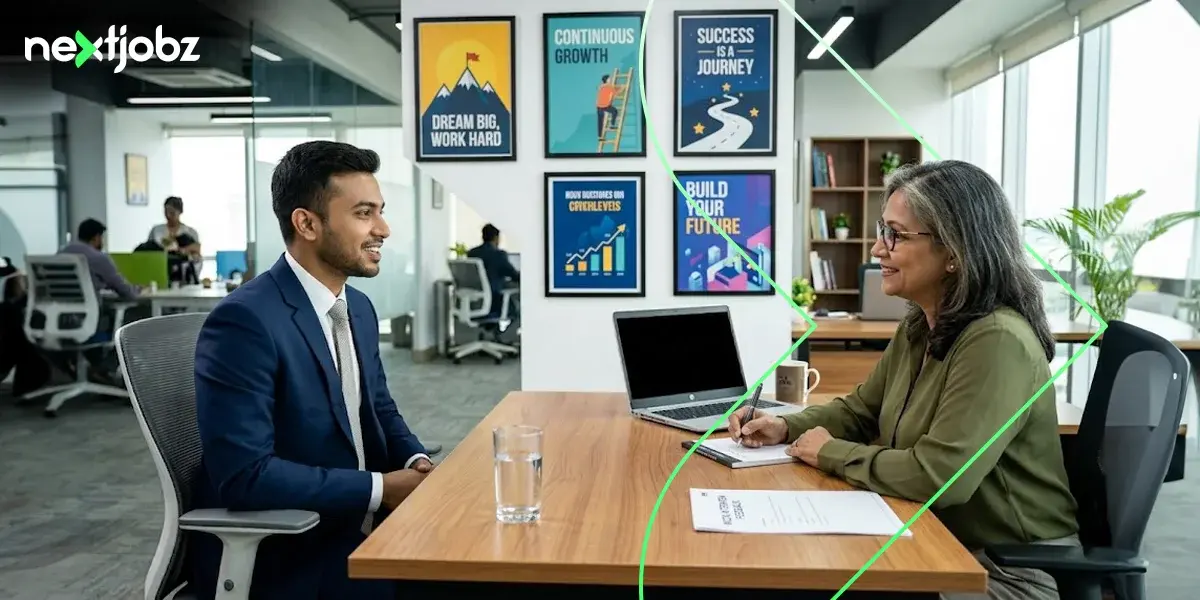
Preparing for a job interview in Bangladesh means more than memorising answers.
It means walking in knowing what employers actually look for, how to carry yourself in a hierarchical setting, and how to follow up in a way that keeps your name at the top of the shortlist.
Whether you are a fresh graduate browsing nextjobz.com.bd for your first role or a professional targeting a senior position at a multinational, this guide covers every step: from initial research to the thank-you email.
Direct Answer: Preparing for a job interview in Bangladesh involves eight key steps: researching the company, practising common questions using the STAR method, preparing your documents, understanding local business culture, dressing conservatively, arriving 15–20 minutes early, handling difficult questions with confidence, and following up within 24 hours.
What Do Bangladeshi Employers Actually Look For in an Interview?
Most candidates walk in focused entirely on answering questions correctly.
Bangladeshi employers are making a deeper assessment: they want to know if you are someone they can trust, work with daily, and rely on long-term.
Technical skills get you shortlisted. Soft skills and cultural fit get you hired.
Here is what interviewers consistently evaluate:
- Communication ability: Can you express ideas clearly in Bangla or English, depending on the role, while maintaining professional body language?
- Respect for hierarchy: Do you address seniors appropriately, show deference without being passive, and understand workplace seniority dynamics?
- Problem-solving and critical thinking: Can you give structured, real-life examples of handling challenges?
- Adaptability: Bangladesh’s workplaces are evolving fast. Employers want to see that you can learn, change, and stay positive under pressure.
- Emotional intelligence: Managing stress calmly, responding with empathy, and showing maturity often matters more than pure technical knowledge.
- Long-term commitment: Employers want to feel you are joining for growth and purpose, not just a salary.
Understanding these expectations before you prepare your answers gives you a massive strategic edge.
Step 1: Research the Company and the Role Thoroughly
Walking into an interview without researching the company is one of the most common and costly mistakes job seekers in Bangladesh make.
Thorough research signals genuine interest, helps you craft tailored answers, and gives you intelligent questions to ask at the end.
How to Research a Company Before an Interview in Bangladesh
Start with the company’s official website.
Read the “About Us” section, their mission statement, current leadership, and any recent announcements.
Then expand to their social media presence: LinkedIn for professional updates, Facebook for local campaigns and community engagement, which matters particularly for Bangladeshi companies.
Look for recent news about the organisation. Are they expanding to new regions? Have they launched a new product?
If you are interviewing at a major telecom, referencing their latest network expansion shows you have done your homework and are genuinely interested. Check industry publications and relevant news portals for this.
Try to speak to people who have worked there.
LinkedIn makes it possible to find current or former employees and send a short, professional message asking about the team culture or the role.
How to Analyse the Job Description Like a Pro
The job description is your interview roadmap.
Read it slowly and identify every required qualification, skill, and responsibility. Then map your own experience against each point.
Extract the keywords the employer used: phrases like “cross-functional teamwork,” “client relationship management,” or “data analysis,” and weave those exact terms naturally into your answers.
This shows alignment without sounding scripted. Ask yourself honestly where your experience matches strongly and where the gaps are. For gaps, prepare a confident explanation of how you are actively learning or how a transferable skill covers the need.
Quick Recap: Research the company website, social media, and news. Map your skills to the job description keyword by keyword.
Step 2: Prepare Your Documents and Portfolio
Arriving at an interview without the right documents is a red flag for any recruiter. Prepare a clean, professional folder containing:
- Multiple copies (at least three) of your updated, role-tailored CV
- Original and photocopies of your academic certificates and transcripts
- National ID card or passport copy
- Portfolio or work samples, if applicable (especially for IT jobs, creative roles, and sales jobs)
- A printed reference list with names, titles, and contact details of 2–3 professional references
- A notepad and pen for taking notes
For bank job interviews specifically, also carry your admit card, the original call letter, and clearly organised document sets: panels often verify everything on the spot.
Quick Recap: Bring at least three CV copies, full document sets, and a portfolio if your role calls for it.
Step 3: Master the Most Common Interview Questions in Bangladesh
Practising common questions in advance removes anxiety and gives you polished, confident responses on the day. Use the STAR method to structure your answers: describe the Situation, the Task you had, the Action you took, and the Result you achieved.
This framework works for nearly every behavioural question.
| STAR Component | What to Include |
| Situation | Brief context: where, when, what was happening |
| Task | Your specific responsibility in that situation |
| Action | Exactly what you did: your decisions, steps taken |
| Result | The measurable outcome: numbers, feedback, change |
Important: Always anchor your STAR answers in real examples. “I once led a team project where…” is far more compelling than “I am a strong team player.”
“Tell Me About Yourself”: How to Answer in a Bangladeshi Context
This is almost always the first question, and it sets the tone for everything that follows. Keep it structured and under two minutes.
Model answer: “Good morning, Sir/Madam. Thank you for this opportunity. My name is [Name]. I completed my [degree] from [university] with a CGPA of [X]. I have [X years of experience/internship experience] in [field], where I focused on [relevant skill or achievement]. I am particularly drawn to this role because [specific reason related to the company or position]. I look forward to contributing meaningfully to your team.”
Avoid reciting your CV verbatim. Highlight two or three relevant accomplishments and close with why you are excited about this specific role.
“Why Do You Want to Work Here?”
This question tests your research and genuine motivation. Reference something specific: a project, a value, a market position, rather than giving a generic answer.
Model answer: “I have followed your company’s work on [specific initiative], and I believe my background in [field] directly supports that direction. I am particularly drawn to the culture of mentoring and growth I have heard about from colleagues in the industry. This feels like an environment where I can contribute and develop.”
“What Are Your Strengths and Weaknesses?”
For strengths, choose one or two that are genuinely relevant to the role and back them with a STAR example. For weaknesses, name a real one, explain how you became aware of it, and describe the concrete steps you have taken to address it.
Model answer (strength): “I have strong analytical skills. In my previous internship, I identified a recurring billing discrepancy in our records. I restructured the tracking system, which reduced errors by 40% over three months.”
Model answer (weakness): “I used to spend too much time perfecting reports before sharing them. I recognised this was slowing team progress, so I now set hard internal deadlines and share drafts for early feedback, which has actually improved the quality of my final outputs.”
“Why Did You Leave Your Last Job?”
Always frame this positively. Never criticise a former employer, manager, or colleague: Dhaka’s professional circles are small, and negative comments reflect poorly on you.
Model answer: “My experience there was genuinely positive, and I grew considerably. I felt I had achieved the key goals I had set for myself in that role, and I am now ready for a new challenge that offers [specific growth opportunity this role provides].”
“Where Do You See Yourself in 5 Years?”
Employers want to see ambition paired with loyalty. Show that you are thinking seriously about your career while framing your growth within the context of contributing to the company.
Model answer: “In five years, I see myself in a senior role where I am leading projects and mentoring junior team members. I want to grow with an organisation I believe in, and based on what I know about your company’s trajectory, I am excited by what that could look like here.”
“What Is Your Expected Salary?” : Negotiating Politely in Bangladesh
Salary negotiation is a skill most Bangladeshi candidates avoid, and it costs them.
Research shows that 55% of professionals accept the initial offer without negotiating, yet 73% of employers say they are willing to negotiate, and over half intentionally offer less than they are prepared to pay.
Before the interview, research market rates using multiple sources.
Reference the BASIS salary survey for tech roles, industry job postings for benchmarks, and professional networks for informal data.
Model answer: “Based on my experience and current market rates for this role, I was expecting something in the range of [X–Y BDT]. I am flexible depending on the full package and growth opportunities. Could you share what range you had in mind?”
If the base salary is fixed, common in banks and government-linked organisations, shift the negotiation to benefits: transport allowance, performance bonuses, training budget, and medical coverage.
Use collaborative language like “How can we make this work?” rather than demands.
“Do You Have Any Questions for Us?”
Never say, “No, I think everything is covered.” Prepared questions signal genuine interest. Strong questions include:
- “What does success look like in this role in the first six months?”
- “How does the team collaborate across departments?”
- “What are the main challenges someone in this position typically faces?”
Quick Recap: Practise every common question out loud using the STAR method. Research salary benchmarks before you go in, and always have two or three questions ready to ask.
Step 4: Understand Bangladesh’s Interview Culture and Etiquette
This is where most guides fall short, and where most candidates lose or win their interviews. Cultural awareness is not a soft-skill extra.
In Bangladesh, it is a core competency that employers evaluate consciously or unconsciously.
Respecting Hierarchy: Titles, Seniority, and Panel Dynamics
In Bangladesh, hierarchy is not just acknowledged: it is respected through active behaviour.
Address all interviewers as “Sir” or “Madam” unless invited to use first names, which is rare in formal settings. When entering a panel interview, greet the most senior person first: usually seated at the centre or head of the table.
In panel interviews, direct your primary answers to the decision-maker while maintaining occasional eye contact with others.
A useful technique: open your answer by acknowledging the senior (“With your permission, Sir, I’d like to share an example…”) before addressing the full panel. This signals both respect and confidence at the same time.
Identify the three roles in any panel: the Gatekeeper (HR), the Influencer (line manager), and the Decider (senior leader). Tailor your emphasis accordingly.
Communication Style: Balancing Confidence and Humility
Bangladesh’s professional culture values indirect communication, collective achievement, and measured confidence.
Avoid framing everything in the first-person singular. Instead of “I drove a 30% revenue increase,” try “Our team achieved a 30% revenue increase, and my role focused on the client acquisition strategy.”
This is not about underplaying your contribution: it is about presenting it within a culturally resonant frame.
Interviewers in Bangladesh tend to be suspicious of candidates who sound too self-promotional, especially in traditional industries like banking, insurance, and textile and garment.
Speak clearly, pause briefly before responding to show thoughtfulness, and avoid interrupting the interviewer even if you know the answer.
When to Speak Bangla vs. English
| Situation | Recommended Language |
| Multinational or international organisation | English (expected throughout) |
| Local private company (conversation in English) | Match the interviewer’s language |
| Local private company (conversation in Bangla) | Switch to Bangla : it shows cultural ease |
| Government-linked roles and NGOs | Bangla is often preferred and signals commitment |
| Tech startups | English for technical content, Bangla acceptable elsewhere |
Follow the interviewer’s lead. Adapting naturally to the language they use shows both confidence and cultural intelligence.
Dress Code for Job Interviews in Bangladesh
First impressions are formed in seconds. Dress conservatively and formally unless you have strong signals that the company culture is casual.
| Aspect | Men | Women |
| Corporate / Banking | Dark suit (navy, black, or grey), white or light-blue shirt, tie, polished formal shoes | Dark pantsuit or formal blouse with skirt/trousers (knee-length or longer), minimal jewellery |
| MNCs / NGOs | Business casual: collared shirt, chinos, polished shoes : tie optional | Smart blouse with tailored trousers or modest formal dress |
| Tech Startups | Neat collared shirt, clean trousers : avoid jeans and sneakers | Smart casual : neat blouse, formal trousers; no activewear |
| Avoid | Bright colours, excessive fragrance, wrinkled clothing, open footwear | Loud prints, heavy makeup, strong perfume, overly casual fabrics |
For bank viva boards specifically, a full dark suit with a tie is expected: it signals seriousness and professionalism to the panel.
Body Language and Non-Verbal Cues
Non-verbal cues speak volumes in Bangladesh’s indirect communication culture. Apply the ROLE method throughout the interview:
- Relaxed posture: sit back comfortably, shoulders loose, not rigid
- Open arms: no crossed arms or legs, which read as closed or defensive
- Lean forward slightly: signals interest and engagement
- Eye contact: maintain steady but not intense contact; slight aversion when a senior is speaking shows respect, not weakness
Stand when a senior person enters the room: this is still practised in traditional firms and leaves a strong impression.
Give a firm (not crushing) handshake if offered, and wait to be invited to sit. Avoid checking your phone, fidgeting, or glancing at the door.
Caution: One candidate famously lost a panel interview for repeatedly checking their watch, which the board interpreted as impatience. Small habits carry big signals in formal Bangladeshi settings.
Quick Recap: Address everyone as Sir or Madam, dress conservatively, frame achievements as team efforts, and apply the ROLE method for body language throughout.
Step 5: Logistics and Day-Of Preparation
Even perfectly prepared candidates undermine themselves with poor logistics. Dhaka traffic alone can derail an otherwise excellent interview day.
The Night Before Your Interview
- Lay out your complete outfit: ironed, clean, and ready
- Pack your document folder with all the required copies
- Confirm the interview time, location, and interviewer’s name
- Plan your route and identify transport options, including a backup
- Review your key notes: company research, STAR examples, salary expectations
- Get to bed early: fatigue affects recall, composure, and body language
How Early Should You Arrive for a Job Interview in Bangladesh?
Arrive 15–20 minutes early.
This gives you time to find the office, calm your nerves, and observe the environment. If the location is new to you, consider doing a dry run the day before to avoid surprises.
Dhaka traffic is notoriously unpredictable, especially during morning rush hours, so always build in an extra buffer.
Best Practice: Never arrive more than 20 minutes early: it can pressure the interviewer and create an awkward wait. The sweet spot is 15 minutes.
What to Do While Waiting
The waiting area is not downtime: it is the opening act. Greet the reception staff warmly and professionally; they sometimes share impressions with HR.
Review your key notes quietly, observe how the office functions, and pay attention to how employees interact. It tells you a lot about the culture you are entering.
Quick Recap: Iron your clothes the night before, plan your route with a Dhaka traffic buffer, and treat the waiting room as part of the interview.
Step 6: Practice, Practice, Practice
Preparation without practice is just theory.
The most confident interviewees are not those who know the most: they are those who have said their answers out loud enough times that the words flow naturally.
How to Do a Mock Interview
Mirror practice: Rehearse your answers in front of a mirror. Watch your expressions, eye contact, and body posture.
Video recording: Record yourself on your phone answering five key questions. Watch the playback critically. Are you using filler words (“ummm,” “actually”)? Are you making eye contact?
Practice with a trusted person: Ask a friend, mentor, or family member to play interviewer. Ask them for honest feedback, not encouragement.
AI simulation tools: Use AI-powered practice tools available on nextjobz that simulate realistic interview conditions and give you structured feedback on your responses.
Aptitude Tests and Group Discussions: What to Expect
This is a critical preparation area that most candidates ignore, and it costs them heavily in bank, MNC, and large corporate hiring processes.
Aptitude tests are standard at Bangladesh Bank, Sonali Bank, Janata Bank, and most major private banks, as well as MNCs during their Management Trainee Officer (MTO) and Probationary Officer (PO) hiring cycles.
These tests assess logical reasoning, numerical ability, verbal comprehension, and sometimes general knowledge, including banking terms, Bangladesh’s monetary policy, and current economic affairs.
Practice using GRE/GMAT-style logical reasoning resources; online quiz platforms in Bangladesh also offer bank-specific aptitude practice.
Group discussions are used to assess leadership, communication, and collaborative problem-solving. Contribute meaningfully without dominating.
Listen carefully to others, build on their points, introduce structure to the discussion, and summarise when appropriate. Interviewers are watching for candidates who lead without monopolising, stay composed under disagreement, and show respect for peers.
Insider Tip: For government jobs and BCS preparation, general knowledge sections often include questions on Bangladesh’s constitution, economic history, and current affairs. Build this into your daily reading habit at least two weeks before your interview.
Quick Recap: Record yourself practising, run at least two full mock interviews, and if you are targeting a bank or MNC, start aptitude test practice at least one week out.
Step 7: Handle Difficult and Culturally Specific Questions
Some questions will catch you off guard. Preparing for them in advance means you will respond calmly rather than react awkwardly.
Personal and Family Questions: How to Respond Professionally
Bangladeshi interviewers sometimes ask about family, marital status, or hometown: questions that would be considered inappropriate in Western contexts but are common here as a relationship-building exercise.
Respond warmly but briefly, then bridge back to your professional value.
Example: “I am from [city], and my family has always been very supportive of my career. I am fortunate to have that foundation: it allows me to focus fully on my work.”
Questions About Religion or Politics: The Graceful Sidestep
Navigate these with care and redirect gracefully.
Example: “I prefer to keep those personal areas separate from my professional life. What I can say is that my values around honesty, hard work, and respect for others are something I bring to every role.”
Stress and Creative Questions
These are designed to see how you think and handle pressure.
There is rarely one correct answer. Take a breath, think for 2–3 seconds visibly: interviewers respect the pause, and then speak through your reasoning clearly. “That is an interesting scenario: let me think through it briefly…” buys you a moment and projects calm.
“Are You Overqualified?” : How to Reframe It
This is an opportunity in disguise.
Model answer: “I understand why that concern exists. I see it differently: my experience means I can add value from day one while developing in new directions here. I am genuinely excited about what this specific role offers, and I am at a stage in my career where quality of work and team culture matter more than title alone.”
Quick Recap: Prepare for personal questions, have a graceful sidestep ready for religion or politics, and reframe “overqualified” as “ready to contribute immediately.”
Step 8: Post-Interview Actions That Most Candidates Skip
The interview ends when you leave the building, but your candidacy continues. Most Bangladeshi job seekers do nothing after an interview. That is a missed opportunity.
How to Write a Thank-You Email After a Job Interview in Bangladesh
Send a brief, professional thank-you email within 24 hours of your interview. This is rare enough in Bangladesh that it immediately distinguishes you.
Template:
Subject: Thank You : [Position Title] Interview
Dear [Sir/Madam / Mr./Ms. Last Name],
Thank you for taking the time to speak with me today regarding the [position] role at [Company Name]. I enjoyed learning about [specific point discussed: a project, a team goal, a company initiative], and I left the conversation even more enthusiastic about the opportunity.
Please find my [CV/portfolio/references] attached for your convenience. I look forward to hearing from you, and please do not hesitate to reach out if you need any further information.
Warm regards, [Your Full Name] [Phone Number] | [Email]
When and How to Follow Up Without Being Pushy
If you have not heard back within the timeframe mentioned during the interview, or one week if no timeframe was given, send a single polite follow-up email.
Keep it to two sentences: express continued interest and ask if there is an update on the timeline.
Never follow up more than twice. Over-communication is interpreted negatively in Bangladesh’s professional culture.
What to Do If You Don’t Get the Job
Rejection is not the end of the relationship. Send a gracious reply thanking them for the opportunity and expressing continued admiration for the company. Connect with the interviewers on LinkedIn with a personalised note referencing your conversation: Bangladeshi companies frequently re-engage past candidates when new roles open.
Ask for feedback where possible: “Would you be able to share any feedback that could help me in future interviews?” Not everyone will respond, but those who do will give you invaluable insight.
Quick Recap: Send a thank-you email within 24 hours, follow up once if you hear nothing after a week, and always respond to rejections graciously.
Quick-Reference Interview Preparation Checklist
Use this table as your preparation timeline to ensure nothing is missed.
| Timeline | Tasks to Complete |
| 1 Week Out | Research company, analyse JD, tailor CV, start practising common questions with STAR examples |
| 3 Days Out | Mock interviews (video/mirror/friend), aptitude test practice, prepare documents folder, plan outfit |
| Night Before | Iron clothes, pack folder, confirm location and route, review notes, rest early |
| Day Of (Morning) | Dress formally, leave early accounting for traffic, arrive 15–20 minutes before time |
| In the Waiting Area | Greet staff professionally, review notes, observe office culture |
| Post-Interview (Same Day) | Send thank-you email within 24 hours |
| 1 Week Later (If No Response) | Send one polite follow-up email |
Preparation is the great equaliser in Bangladesh’s competitive job market.
The candidates who get hired are rarely the most qualified on paper: they are the ones who arrived ready, communicated with cultural intelligence, and followed up professionally. Use this guide as your roadmap, practise consistently, and approach every interview as a conversation between two parties assessing mutual fit.
Your next opportunity is already listed on nextjobz. Go find it: then walk in ready to win it.
Frequently Asked Questions About Job Interviews in Bangladesh
What should I wear to a job interview in Bangladesh?
Wear dark, conservative formal attire. Men should opt for a suit or smart formal shirt and trousers; women should wear a formal blouse with tailored trousers or a modest skirt. Avoid bright colours, excessive accessories, and casual fabrics regardless of the industry.
How do I introduce myself in a Bangladeshi job interview?
Open with “Good morning Sir/Madam,” then give a 90-second overview: your name, educational background, relevant experience or skills, and why you are excited about this role. Close with a line of gratitude. Keep it professional, clear, and relevant.
How do I prepare for a bank job interview in Bangladesh?
Bank interviews in Bangladesh typically involve a written aptitude test covering logical reasoning, numerical ability, verbal comprehension, and general banking knowledge, followed by a formal viva panel. Study banking terminology, Bangladesh Bank’s monetary policy, and current economic issues. Practise presenting yourself formally and dress in a full suit for the panel.
How should I negotiate salary in Bangladesh?
Wait for a written offer before negotiating. Research market rates using multiple sources, then present a specific range backed by data. Use collaborative language and be open to negotiating the full package: transport allowance, performance bonus, and training budget, if the base is fixed.
Should I speak in Bangla or English during an interview?
Follow the interviewer’s lead. If they begin in English, respond in English. If the conversation shifts to Bangla, adapt accordingly. In multinational or international organisations, English is generally expected. In local companies, NGOs, and government-linked roles, Bangla may be more appropriate and even preferred.
What about virtual or online interviews?
Virtual hiring is increasingly common in Bangladesh, especially in tech, NGOs, and international organisations. Test your camera, microphone, and internet connection at least an hour before. Choose a clean, quiet, well-lit background. Maintain eye contact by looking at the camera (not the screen), dress as you would for an in-person interview, and keep brief notes nearby without reading directly from them.
I am a fresh graduate with no work experience. What should I emphasise?
Lead with your academic achievements, final-year projects, and extracurricular leadership. Frame internships: even short ones: with STAR examples. Emphasise transferable soft skills: teamwork from university projects, leadership from student clubs, and communication from presentations. Show genuine enthusiasm to learn, and be honest about gaps: interviewers respect self-awareness far more than fabricated experience.