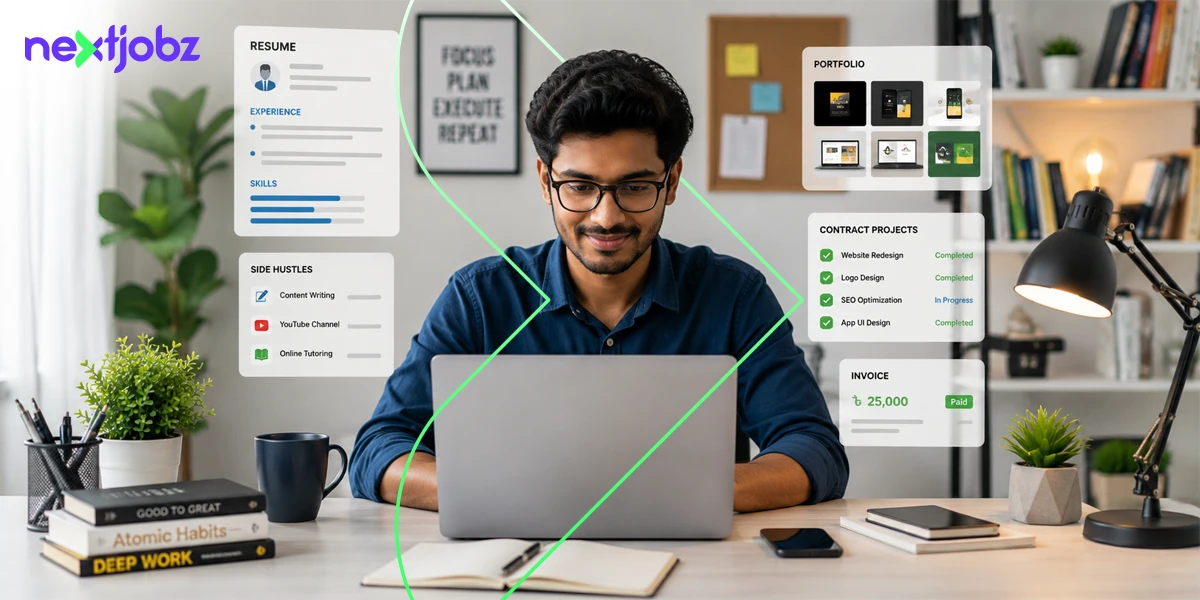

Personal branding for the job market 2026 is the strategic process of building a visible, credible, and consistent professional identity across digital platforms. It means recruiters and hiring managers can verify your value before any formal application, interview, or conversation takes place.
In a market driven by AI discovery and digital pre-screening, your brand is what gets you found
You updated your CV. You applied to job after job. You heard nothing back.
It is not because you are underqualified. It is because you were never discovered in the first place.
This is the reality facing thousands of job seekers right now, from fresh graduates in Dhaka to mid-career professionals aiming for roles in the UK, UAE, and beyond. The job market has reorganized itself in a way most people have not registered yet.
Recruiters no longer wait for applications to land in their inbox.
They search LinkedIn, Google, and AI-powered sourcing tools to find and verify candidates before a single job post goes live. If your digital identity is unclear, inconsistent, or invisible, you simply do not appear. Someone else fills the gap.
If you want to find jobs that match your personal brand, you first need to build the brand that makes those jobs come looking for you. This guide covers every step of that process, from defining your core story to building a personal portfolio website 2026 to optimizing your LinkedIn profile for AI discovery.
By the end, you will have a complete, actionable setup built for the realities of the 2026 job market.
The old hiring sequence was: apply, interview, prove yourself.
The new sequence is: be discovered, be verified, be contacted. The professionals winning in 2026 are not necessarily the most qualified. They are the most readable.
What Personal Branding for the Job Market Actually Means in 2026
Personal branding for the job market 2026 is the deliberate management of how you appear, communicate, and are verified across digital platforms.
It combines your professional narrative, online presence for job seekers, proof of work, and consistency of message to create a trusted identity that attracts career opportunities before a CV is ever opened.
Most people hear the words “personal branding” and think it is something reserved for influencers or senior executives. It is not.
It is how a 24-year-old software engineer from BRAC University gets noticed by a Singapore tech firm.
It is how a finance professional in Dhaka lands a conversation with a hiring manager in Dubai before ever submitting a formal application.
It is professional infrastructure, not a marketing exercise.
Three forces arrived at the same time in 2026, and together they changed everything. First, AI now sits between you and the person searching for you.
Most hiring journeys begin with a search, and a significant share now run through generative AI tools. If those systems cannot identify who you are, what you stand for, and why you are relevant, you simply do not appear.
Second, trust has shifted away from institutions. Research consistently shows that people trust individual voices far more than corporate messaging, which means professionals who show up in a human, recognizable voice carry more credibility than polished company pages ever could.
Third, individual voices outperform brand accounts on every major platform.
Research cited by Speakap found that 76% of people trust content shared by individuals more than content from brands, and employee-generated posts receive eight times more engagement than corporate posts on the same topic.
Taken together, these forces make one thing clear. Your personal brand is not optional in 2026. It is the first filter between you and every opportunity worth having.
The five pillars that matter:
| Pillar | What it means | Why it matters in 2026 |
| Clarity | Who you are and what you offer | Recruiters and AI tools decide in seconds |
| Credibility | Evidence that backs your claims | Trust is built before you meet |
| Consistency | The same story across all platforms | Inconsistency signals unreliability |
| Visibility | Being findable by the right people | Opportunities go to those who appear in searches |
| Proof of Work | Showing process, not just results | AI generates polished outputs; humans show thinking and trade-offs |
Why Your Personal Brand Is the New Resume in 2026
Your personal brand job search strategy begins the moment someone types your name into a search bar.
That moment happens far more often than you think, and it happens before any formal application is ever submitted.
According to a CareerBuilder survey published on PR Newswire, over 70% of employers screen candidates on social media before hiring, and more than half have rejected candidates based on unprofessional or inconsistent online content.
More than half have rejected candidates based on unprofessional or inconsistent online content. Your digital presence is a pre-screening checkpoint that exists whether you built it intentionally or not.
The question is whether you are in control of what it says about you.
Professionals with strong personal brands are treated as authorities before a single conversation takes place. Inbound opportunities convert at significantly higher rates than cold applications. Your brand is the engine behind that difference.
Traditional Resume vs. 2026 Personal Brand:
| Dimension | Traditional Resume | 2026 Personal Brand |
| Format | Static document | Living digital presence across LinkedIn, portfolio, and content |
| Content | Lists responsibilities | Demonstrates process, impact, and communication style |
| Timing | Submitted the application | Discovered before the application |
| Targeting | Generic | Calibrated to a specific niche or specialty |
| Verification | References on request | Public social proof, case studies, endorsements |
| Opportunity type | Reactive | Creates inbound interest |
| Personality | None | Shows values, voice, and how you think |
This comparison matters for Bangladeshi professionals especially.
Many still rely on a traditional CV submission model. But the roles worth having, whether locally in Dhaka or internationally in London, Toronto, or Dubai, are being filled by candidates who were already visible before the job was ever posted.
Modern applicant tracking systems and AI recruiting tools now look beyond keyword density.
These tools evaluate patterns of consistency, credibility, and engagement across a candidate’s entire digital identity. A strong personal brand job search strategy warms up your candidacy.
When a recruiter has already seen your LinkedIn content or read your portfolio case studies, they are far more likely to manually pull your application rather than let it sit in an automated rejection queue.
This is why inbound and referral-driven applications convert at significantly higher rates than cold submissions. And it is exactly why building your brand is not about vanity. It is about survival in a market that moved on without announcing it.
Pro Tip: Run a quick Google search on your own name right now. What appears in the first five results is exactly what a recruiter sees. If you are not managing that page, someone else’s version of you is doing it for you.
Step 1: Define Your Core Narrative Before You Build Anything
Your core narrative is the strategic foundation of your entire how to build a personal brand journey.
It defines what you stand for, who you help, and what makes your professional identity distinct, before you write a single word of copy or update a single profile.
Most professionals skip this step and go straight to updating their LinkedIn headline or choosing a portfolio template. That is backwards. Without a clear narrative, every platform you build on becomes noise instead of a signal.
Start with one clarifying question.
What do you want people to say about you when you are not in the room? Cross-reference that with real-world feedback.
Ask three to five trusted colleagues or clients for three to five words that describe you professionally. Map the patterns. Your brand is rarely a reinvention. It is a more intentional, consistent version of who you already are, built around one or two central themes.
Defining your Unique Value Proposition
A strong UVP answers three questions in one sentence: What do you do? Who do you help? What makes you different?
Avoid empty claims. “Strategic,” “results-driven,” and “innovative” communicate nothing without specific evidence behind them.
A weak UVP: “Experienced marketing professional.”
A strong UVP: “Performance marketing strategist who helps B2B SaaS companies halve their cost-per-acquisition through full-funnel content and paid search alignment.”
Forbes personal branding expert William Arruda found that clarity is the single most important pillar of a personal brand in 2026.
Recruiters and AI tools must understand what you offer within seconds. Without clarity, even strong professionals get skipped in a crowded, automated hiring market.
Defining your anti-persona
Equally important to knowing who you are is knowing who you are not. The anti-persona is the deliberate decision to exclude certain audiences, roles, or types of work from your positioning.
An example: “I lead product strategy for fintech companies, not consumer apps, not enterprise SaaS.”
This specificity is a credibility signal, not a limitation. It tells AI tools and human readers that you know your lane. That is far more reassuring than a profile claiming expertise in everything.
Writing your personal brand statement
Your brand statement is a two to three-sentence summary that combines your UVP, anti-persona, and values.
Use it across LinkedIn, your portfolio homepage, your resume summary, and your interview introduction. Consistent use of the same statement across platforms creates the repeated pattern that AI search systems use to identify and surface you as a credible voice in your field.
Own your digital foundation
Your brand lives across platforms you do not control. LinkedIn, X, Instagram.
Any of them can change their algorithm, restrict your reach, or alter their policies overnight. A personal website, your own domain with your own analytics and content structure, is the only digital space you fully own. It is the permanent address in a landscape full of rented space.
If you are not sure where to start with your positioning, access career guidance to support your personal brand built specifically for professionals navigating the 2026 job market.
Step 2: The 2026 Personal Brand Tech Stack
The 2026 AI-ready portfolio tech stack is the combination of platforms, tools, and systems that supports your digital identity, from building and publishing your brand to tracking its performance and attracting the right opportunities.
You do not need everything on this list.
You need the right combination for your goals and budget. According to the Copyfolio blog on personal branding tools, a lean starter budget of approximately $30 per month covers a portfolio website, a design tool, and content scheduling.
That is everything you need to build a complete, professional digital presence.
The 2026 Brand Tech Stack: Free vs. Paid
| Platform / Tool | Purpose | Best for | Cost |
| Professional discovery, networking, content | All professionals | Free / Premium | |
| Carrd | One-page personal site | Freelancers, minimalists | Free; Unlimited from $19/yr |
| Framer | Modern no-code portfolio builder | Designers, creatives | Free; paid from ~$15/mo |
| Copyfolio | Portfolio and case study website | Creatives, writers | $15/mo or $9/mo annually |
| Ghost | Blog and newsletter for thought leadership | Writers, consultants | From $9/mo |
| Notion (public) | Open portfolio and case study hub | Developers, PMs, analysts | Free / Paid |
| GitHub | Live code and project portfolio | Developers, engineers | Free |
| Canva | Visual brand assets and resume design | All professionals | Free; Pro from $15/mo |
| Loom | Short-form video introductions | All professionals | Free; Business from ~$13/mo |
| Jobscan | ATS keyword optimisation | Active job seekers | Paid from ~$49/mo |
| Google Analytics | Portfolio traffic and behaviour tracking | All professionals | Free |
One-page vs. multi-page portfolio:
| One-page | Multi-page | |
| Best for | Freelancers, creatives, minimalists | Consultants, executives, thought leaders |
| Navigation | Scroll-based | Menu-based |
| SEO potential | Moderate | High |
| Case study depth | Limited | Extensive |
| Setup speed | Fast | Longer |
For most Bangladeshi professionals starting out, a free Carrd site or public Notion page combined with a strong LinkedIn profile is more than enough to begin generating inbound interest.
The goal is not perfection. The goal is visibility.
Step 3: Optimize Your LinkedIn for AI and Recruiter Discovery
LinkedIn personal branding 2026 goes beyond filling in profile sections.
It means structuring your profile so that both human recruiters and AI-powered search tools can immediately understand who you are, what you offer, and why you are relevant to specific roles.
According to LinkedIn’s Future of Recruiting 2024 report, 72% of recruiters use LinkedIn as their primary talent discovery and vetting tool. Profiles anchored to three to five consistent professional themes accumulate compound visibility.
Their posts travel further, their names surface more reliably in recruiter searches, and their authority builds with each new contribution. Complete profiles are 40 times more likely to receive job opportunities.
The LinkedIn algorithm has also shifted from rewarding broad popularity to rewarding topic relevance.
It now boosts profiles and content from users who stay consistently focused on a defined area of expertise. That means your next move is not to post more. It is to post smarter, around a tight cluster of themes that reflect exactly what you want to be hired for.
Your LinkedIn Optimization Checklist for 2026:
☐ Professional, current profile photo
☐ Banner image that communicates your specialty and positioning, not just your company logo
☐ Headline written as a value statement, not a job title. Example: “SEO Content Strategist | Helping Digital Agencies Scale Organic Traffic | B2B and SaaS”
☐ About section written in first-person narrative covering problem, solution, values, and a clear CTA
☐ Experience section with quantified results, not task descriptions. “Grew organic traffic by 3x in 8 months,” not “Managed content”
☐ Skills section populated with role-specific keywords recruiters actually search
☐ At least 3 detailed recommendations from colleagues, managers, or clients
☐ Featured section with Loom video intro, case study PDF, and portfolio link
☐ Creator Mode is enabled if you publish content regularly
☐ Posted at least once in the last 30 days
☐ Custom profile URL (linkedin.com/in/yourname)
☐ Open to Work settings reviewed and updated
The Featured Section is LinkedIn’s most underused tool
Place a 60 to 90-second Loom video introduction as your first Featured item.
Summarize your UVP, who you help, and one current project you are proud of. Behind the video, add a downloadable case study PDF and a direct link to your portfolio website.
Together, these three items create a mini brand dossier. Everything a recruiter needs to verify your credibility is in under three minutes.
Video content on LinkedIn receives substantially higher reach and engagement than text-only posts. A personal video immediately humanizes your profile in a way no written summary can replicate.
What to post and how often
Consistency matters far more than volume.
Posting two to three times per week around a small cluster of professional themes signals ongoing expertise and keeps your profile active in recruiter discovery feeds.
Content that performs in 2026 is demonstrably human.
Posts that reveal how you think through a problem, describe a decision made under uncertainty, or share a lesson from a setback are doing something AI tools cannot. They show a mind at work.
Use this simple framework: situation, challenge, action, result, reflection. That is the formula that turns a LinkedIn post into a trust signal.
Hot Tip: Avoid posting without engaging. Responding to comments and sending thoughtful connection requests shows both the algorithm and recruiters that you are an active participant, not a broadcaster.
Step 4: Build a Portfolio Website That Works While You Sleep
A personal portfolio website 2026 is your own digital headquarters.
It is the platform where you control the complete narrative of your professional identity, showcase proof of work, and convert visitor interest into career opportunities, without depending on any third-party algorithm or policy.
A personal website works for you 24 hours a day as a personal branding and opportunity generation engine. Recruiters in London, Dubai, or Toronto can find you, verify you, and decide to reach out without you ever knowing they visited.
Your homepage must immediately answer three questions.
- Who are you?
- Who do you help?
- What makes you different?
A recruiter who cannot answer those questions within ten seconds will leave. Do not bury this information. Put it right at the top, in plain language.
Work samples and case studies are where most portfolios fall short. The most valuable thing a 2026 portfolio can show is your thinking.
The decisions you made, the trade-offs you navigated, and the approach you took when the problem was messy. AI can generate polished outputs. Only you can document the process that produced them.
The most effective case studies follow this format:
| Element | What to include |
| Project title | Clear, role-specific, and outcome-focused |
| The problem | Client or business challenge in plain language |
| Your process | Steps taken, tools used, decisions made |
| The messy middle | Obstacles, pivots, and how you navigated them |
| The outcome | Quantified results and business impact |
| What you learned | Reflection that signals growth and self-awareness |
| Proof assets | Screenshots, data, testimonials, live links |
The “messy middle” is the section most professionals skip.
It is also the section recruiters find most revealing. Showing how you handled a project that did not go as planned tells an employer far more about your actual capability than a highlight reel of polished wins.
Every significant project must include quantified outcomes. Conversion rates, revenue impact, audience growth, efficiency gains. Numbers turn descriptions into evidence. “Improved user engagement” means nothing. “Grew Instagram engagement by 150% in 6 months through targeted content strategy” means something.
Add testimonials and endorsements, with video testimonials carrying the highest credibility weight. Include a clear contact form or booking link with a direct call to action placed prominently, not buried in a footer.
Technical essentials for 2026
Your portfolio must be mobile-optimized, fast-loading, and structured for both human readability and search engine discovery. Site audit checklist, Core Web Vitals compliance is now a baseline requirement for any professional portfolio.
The technical requirements are:
- Responsive design across all device sizes
- Core Web Vitals compliance (Google’s page experience metrics)
- Person Schema markup, which is structured data that helps AI systems correctly identify and surface you in relevant searches
- Custom domain (your name, your asset, permanently owned)
- Google Analytics is installed and tracking, so you know which case studies attract recruiters and which pages lose them
Important: If your portfolio page loads slowly or breaks on mobile, a recruiter will leave before reading a single word. Speed and mobile design are not optional in 2026.
Content That Proves You Are Human in a World Full of AI
In 2026, personal brand content strategy has shifted from volume-based creation to insight-led curation.
The professionals who win are not those who post the most. They are those who share the most human, specific, and experience-backed perspectives in a market flooded with AI-generated content.
AI can generate generic posts, templated advice, and polished how-to lists in seconds.
What AI cannot replicate is your lived experience, your opinions, your mistakes, and the specific way you think through problems in your field.
Content that only you could have written, from situations only you have experienced, is now the key trust signal in a market trained to be suspicious of anything that looks too finished. Depth and specificity separate remembered voices from ignored noise.
Content type matrix:
| High human insight | Low human insight | |
| High-reach platform | LinkedIn personal story posts, process breakdowns | Generic tips, motivational quotes, AI-generated threads |
| Owned channel | Substack deep-dives, personal blog case studies | Reshares without commentary |
Prioritize the top-left quadrant. Every time.
For Bangladeshi professionals, especially, this is a real competitive advantage.
Sharing your experience navigating the local job market, building skills without traditional resources, or working across industries that are rapidly changing, that content carries weight because it is genuinely yours. No AI can write it. No one else has lived it.
Where to post and why
LinkedIn is your primary platform for process breakdowns, lessons learned, career reflections, and industry commentary with a real point of view.
Your personal website or blog builds long-form case studies and SEO-optimized articles that attract search traffic over time.
Ghost or Substack builds thought leadership newsletters for niche authority and owned audience development. Loom or LinkedIn Video delivers short-form video introductions and project walkthroughs of 60 to 120 seconds.
GitHub provides live proof of technical process and capability for developers.
Short-form video on LinkedIn is among the fastest-growing trust signals for professionals. A Loom walkthrough of a case study on your portfolio website simultaneously proves process, communication skills, and personality.
Three things a CV cannot demonstrate. You do not need production quality. Authenticity and clarity outperform polish every time.
Networking and Social Proof That Compounds Over Time
Your network amplifies your brand in ways that content alone cannot.
Referrals and word-of-mouth still convert at the highest rates of any job search strategy. Every genuine professional relationship is a potential source of both.
Building your network with intention means attending industry events, webinars, and virtual meetups, asking questions, and following up personally.
It means joining professional communities on LinkedIn groups, Slack channels, and industry-specific forums. It means giving before you get, sharing job postings, making introductions, and offering honest feedback.
For developers and researchers, contributing to open-source projects or industry publications builds public proof of work that AI search systems can find and surface.
Social proof in the age of AI hiring
Move beyond written LinkedIn recommendations.
Pursue video testimonials from colleagues and clients. Video endorsements carry significantly higher credibility signals in AI-assisted hiring environments, where trust verification is partly automated.
A 30-second video from a former manager describing exactly how you approached a problem is more valuable than ten generic written endorsements. Ask for endorsements that speak to specific outcomes and working style.
Not “great to work with,” but “Layla rebuilt our content pipeline from scratch after the rebrand, which reduced production time by 40% and increased output by 3x.” Specificity is what makes social proof credible rather than decorative.
LinkedIn now rewards professionals who consistently post about a defined cluster of topics over those who post broadly.
Three to five professional themes, repeated consistently over months, creates what the platform’s algorithm recognizes as niche authority. This boosts your content reach and surface rate in recruiter searches. AI search systems work the same way. They identify patterns, not one-off contributions.
A clear, repeated professional footprint across posts, articles, interviews, and profiles makes you legible to the systems that decide who gets discovered.
Why Most Personal Brands Fail Before They Get Started
Most personal brands fail not from lack of talent, but from lack of structure, consistency, and specificity. The mistakes are consistent and entirely avoidable.
Over-branding without substance is the first trap.
Aesthetic-first profiles with polished visuals and no proof of capability behind them signal style over substance. Recruiters see through it quickly.
Under-positioning is the second.
Many Bangladeshi professionals stay invisible online because self-promotion feels uncomfortable in their cultural context. The discomfort is real and understandable. But invisibility costs far more than any moment of awkwardness.
Inconsistency across platforms destroys recruiter trust instantly.
A different bio, different headline, and different story on each platform creates doubt that no individual achievement can overcome. If your LinkedIn says one thing and your portfolio says another, a recruiter will not investigate further. They will move on.
Empty buzzwords communicate nothing. “Dynamic,” “innovative,” and “results-driven” mean nothing without specific, evidenced backing. Every claim needs proof behind it.
Neglecting engagement is another killer.
Publishing content without replying to comments creates a one-way broadcast, not a brand. Sporadic activity, disappearing for months and then restarting, signals unreliability to both people and platforms.
Skipping the digital footprint audit is perhaps the most overlooked mistake. Old, unprofessional, or inconsistent content from years ago still exists, still surfaces, and still costs opportunities. Google yourself before you build anything.
Warning: Before you optimize a single profile, audit your existing digital footprint. Search your name in incognito mode and review every result on the first two pages.
How to Know If Your Personal Brand Is Actually Working
Measuring personal brand ROI in 2026 means tracking the signals that show your brand is attracting the right audience, not just any audience. Visibility alone is not success. The conversion from visibility to conversation is the real measure.
Leading indicators to track every month:
- ☐ LinkedIn profile views trending upward week over week
- ☐ Profile appearing in recruiter searches (track via LinkedIn Search Appearances in your analytics dashboard)
- ☐ Inbound recruiter messages increasing in quality and role relevance
- ☐ Post engagement including saves, comments, and shares from industry-relevant profiles, not just likes
- ☐ Direct messages from peers, collaborators, and hiring managers
- ☐ Interview invitations aligned with your target specialty and seniority
- ☐ Referrals arriving without prompting
- ☐ Portfolio website traffic increasing, with low bounce rates on case study pages
- ☐ Speaking, collaboration, or podcast invitations in your niche
- ☐ Being tagged, shared, or mentioned by others in your field
The conversion principle runs like this: visibility leads to interest, interest leads to conversation, conversation leads to opportunity.
If visibility is high but conversations are low, the problem is clarity or specificity. Your brand is being seen but not understood. If conversations are high but opportunities are low, the problem is targeting.
You are attracting the wrong audience. LinkedIn’s Social Selling Index is a practical diagnostic tool for tracking credibility, engagement, and relationship-building across all four dimensions.
Use it monthly, not once and never again.
The Quarterly Brand Reset Every Professional Needs
Use the start of each quarter as a structured recalibration moment.
Update your resume with quantified achievements and have it ready before opportunity arrives. Refresh your LinkedIn photo, banner, headline, and bio to signal professional evolution to the market. Review your personal bios across all platforms, including your company website, speaker profiles, and social platforms.
They drift apart faster than you think.
Review your last 90 days of content output. Are you staying anchored to your three to five core topics, or drifting? Check which portfolio pages and LinkedIn posts drove the most recruiter engagement. Double down on what is working.
Cringing at old content is not a failure signal. It is a growth signal. It means you have evolved. Acknowledge it, update it, and move forward.
Your skills are real. Your experience is earned. But in 2026, none of that matters if no one can find you, read you, or trust you within seconds of landing on your profile.
Bangladesh’s talent is world-class.
The professionals getting hired for the best roles, both here and globally, are not always the most qualified. They are the clearest, the most consistent, and the most credible. They built their brand before they needed it.
And when opportunity came looking, they were already visible, already verified, and already trusted.
Your next move starts now.
Frequently Asked Questions
What is personal branding for the job market in 2026?
It is the strategic process of building a visible, credible, and consistent professional identity so recruiters can verify your value before any formal application takes place.
Do I need a personal portfolio website in 2026?
Not mandatory, but it significantly increases your credibility by giving you a space you fully own to showcase real projects, outcomes, and your professional process.
How does a personal brand help with AI ATS systems?
It warms up your candidacy so recruiters who have already seen your content are more likely to manually review your application rather than leave it in an automated queue.
How often should I post on LinkedIn to build a personal brand?
Two to three times per week around a defined cluster of professional topics is enough to signal ongoing expertise and stay active in recruiter discovery feeds.
What is the most important element of a personal brand in 2026?
Clarity, because recruiters and AI tools must understand who you are and what you offer within seconds or they move on.
How much does a portfolio website cost in 2026?
Free with Carrd or Notion, $9 to $25 per month for mid-range options like Framer or Copyfolio, and $500 to $3,000 or more for a fully custom-coded site.
Can personal branding replace traditional job applications?
No, but it increases inbound recruiter interest, referrals, and warm introductions, reducing your reliance on cold applications.
How long does it take to build a personal brand?
An optimized LinkedIn profile and portfolio can be set up in two to four weeks, but building genuine niche authority and recruiter recognition takes three to six months of consistent activity.