
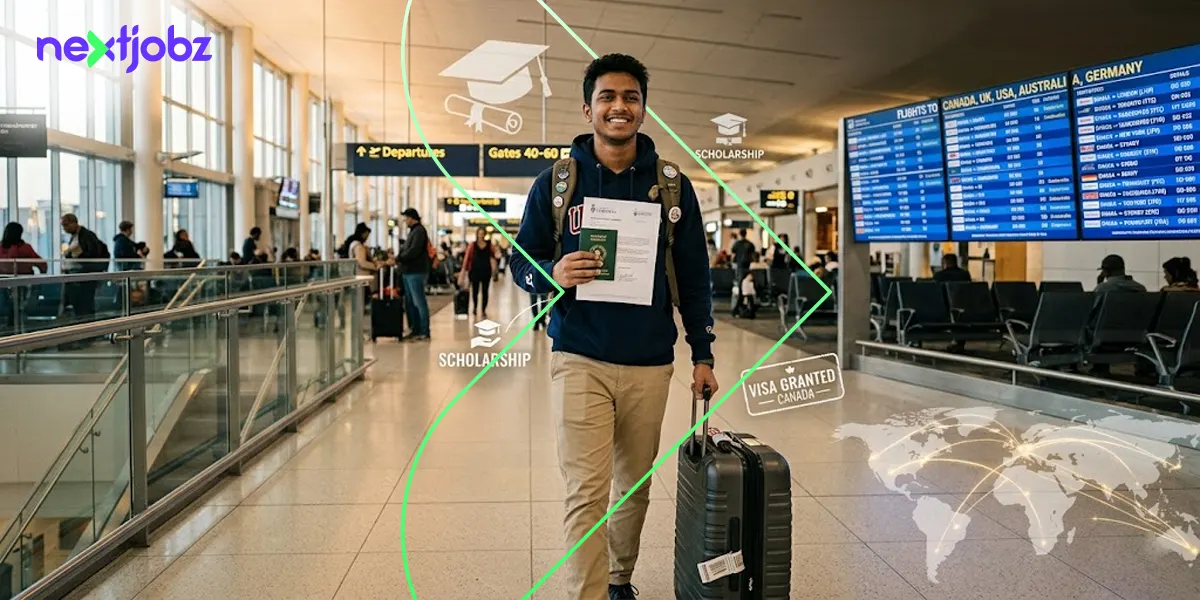
Your degree won’t get you there alone. Your strategy will.
Studying abroad from Bangladesh is one of the most powerful career moves you can make. An international degree opens doors to higher salaries, global networks, and PR pathways that a local degree simply can’t match.
But the process is full of traps, wrong country choices, missed deadlines, weak applications, and expensive guesswork.
This study abroad guide walks you through every step.
From picking the right career goal to boarding your flight with a visa in hand, it’s all here. Start by exploring study abroad opportunities to see what’s available for Bangladeshi students right now.
What Is a Study Abroad Guide and Why Bangladeshi Students Can’t Afford to Skip It
A study abroad guide is a step-by-step roadmap that takes you from “I want to study abroad” to a confirmed university seat, scholarship award letter, and valid visa.
It replaces scattered Facebook advice, uninformed agents, and last-minute YouTube panic with a clear, structured process.
For Bangladeshi students, this matters more than most.
Bangladesh produces hundreds of thousands of graduates every year into a highly competitive local market. An international degree from a recognised university can change your career trajectory entirely, with better salaries at home, jobs abroad, PR pathways, and a professional network that stays with you for life.
The difference between students who succeed and students who spend lakhs and come back with regrets? Planning. Strategy. Starting early.
How to Study Abroad from Bangladesh – Your Step-by-Step Roadmap
The step-by-step study abroad process works in sequence. Skipping steps creates problems downstream. Follow this order.
Step 1: Get Clear on Your Career Goal First, Course Second
Every successful study abroad journey starts with one question: What kind of work do you want to do in five years? Corporate finance? Software engineering? Public health policy?
Once you know the answer, you pick the subject, not the other way around.
The most common and costly mistake Bangladeshi students make is picking a destination country first, then reverse-engineering a course to fit it.
Browse trusted job portals in Bangladesh to see which skills employers are actually paying for right now, then choose your subject with that data in hand.
Step 2: Pick the Country and University That Actually Fits Your Plan
Once you have a subject, compare countries on what actually matters:
- Tuition cost and living expenses
- Part-time work rights during study
- Post-study visa options and PR pathways
- Visa approval rates for Bangladeshis
Top destinations include Canada, the UK, the USA, Australia, Germany, the Netherlands, Sweden, Japan, Malaysia, and China.
Build a shortlist of 8-12 universities across three tiers: 3-4 ambitious targets, 4-5 realistic matches, and 2-3 safe options.
Applying only upward or only downward is a losing strategy either way.
Step 3: Crack IELTS or Find a Smarter Alternative
Most study destinations require proof of English, and IELTS for study abroad is accepted by over 12,500 organisations in more than 140 countries.
Start preparing 3–6 months before your planned test date. Most students underestimate how long real improvement takes and end up rushing or re-sitting multiple times.
If IELTS isn’t right for you, TOEFL iBT, PTE Academic, and Duolingo English Test are accepted by a growing number of institutions. Always check the official admissions page before booking.
Note: Even if a university waives IELTS, the student visa in countries like the UK, Canada, and Australia usually still requires an approved English test score.
Step 4: Build Your Scholarship Positioning Profile Before You Apply
This is the step most students skip, and it’s why so many scholarship applications fail.
Scholarship positioning means deliberately building your academic record, leadership experience, and extracurriculars over 6–18 months to match what selection committees look for.
It is not a last-minute essay task. Focus on consistent grades, meaningful leadership, community work, and research projects you can document.
The clearer your profile, the stronger your scholarship case.
Step 5: Write Documents That Open Doors – SOP, CV, LOR
Three documents carry most of the weight: your Statement of Purpose, academic CV, and Letters of Recommendation. Generic, copy-pasted documents are easy to detect and are among the most common reasons for rejection.
Tailor every document to the specific program you’re applying to.
nextJobz’s AI-powered CV builder helps Bangladeshi students create ATS-compatible, globally formatted academic CVs. Start there, then build outward.
Pro Tip: Read the guide to common CV mistakes to avoid before finalising any document you’re sending abroad.
Step 6: Apply to Universities – Then Scholarships
Submit applications through official portals or centralised systems like UCAS for UK undergraduate programs.
Apply early; many universities review scholarship packages alongside admissions for early applicants, meaning late submissions miss internal funding windows entirely.
For scholarships: government awards, university fellowships, and external programs all open 9–12 months before intake.
Build a separate scholarship calendar and treat every deadline as non-negotiable.
Step 7: Nail Your Visa and Pre-Departure Prep
After securing an offer and financial proof, start the visa process immediately.
Countries like the USA require a dedicated embassy interview; prepare consistent, honest answers that match your documents exactly.
Inconsistencies raise red flags and increase refusal risk.
Heads Up: Always verify visa requirements on official government websites. Immigration policies change regularly, and agents often work from outdated information.
Book flights early, arrange accommodation, and make digital and physical backups of every document. Before you leave, update your CV – part-time job searches in your destination often start within weeks of arrival.
Study Abroad Requirements – What You Actually Need to Qualify
Study abroad requirements vary by country and program level, but several fundamentals apply almost everywhere.
Academic Requirements and English Proficiency
For undergraduate programs, universities review SSC and HSC results.
For master’s, Bachelor’s GPA is the primary metric; most require a CGPA of 3.0/4.0 or higher, with top programs requiring 3.5+.
PhD applications weigh research output and supervisor fit most heavily.
IELTS score requirements for universities vary by destination:
| Destination | Typical IELTS Requirement |
| UK | 6.0-7.0; top programs often 7.0+ |
| Canada | 6.5 overall, minimum 6.0 per band |
| Australia | 6.0-6.5; health programs often 7.0+ |
| USA | 6.0-7.5+, depending on institution |
| Europe | 6.0-6.5 for English-medium programs |
Sub-band scores matter as much as the overall band. A 7.0 overall means nothing if writing is at 5.5 and the program requires a 6.5 minimum in all bands.
Documents, Financial Proof, and Visa Requirements
A standard international application from Bangladesh requires:
- Valid passport with at least 18 months remaining validity
- SSC, HSC, and Bachelor’s transcripts and certificates
- English language test score report
- Statement of Purpose, Academic CV, and 2–3 Letters of Recommendation
- Proof of funds and bank statements
- Application form confirmation and fee receipts
Bank statements usually need to reflect funds over a sustained period; the UK requires a 28-day window, so last-minute large deposits create credibility issues with visa officers.
Visa frameworks by country:
- UK: Student Visa requires a Confirmation of Acceptance for Studies (CAS)
- Canada: A Student Permit requires a Letter of Acceptance, proof of funds, and biometrics
- USA: F-1 visa requires an I-20 form, a SEVIS fee of approximately $350, and an embassy interview
IELTS for Study Abroad – Everything You Need to Know
IELTS for study abroad is the single most flexible English qualification for Bangladeshi students, accepted by over 12,500 organisations in more than 140 countries.
The Academic module is required for university admission. The General Training module is for immigration only.
IELTS Score Requirements and Scholarship Thresholds
Meeting the minimum entry score gets you considered. Scoring well above it gets you funded. Fully funded scholarships typically demand more:
- Chevening and Commonwealth: Generally 6.5–7.0
- Erasmus Mundus: Commonly 6.5 or above
- Australia Awards: At least 6.5 overall
Successful scholarship awardees often score significantly above the minimum; high English proficiency signals academic readiness to selection committees.
IELTS vs TOEFL – Which One Gives You a Better Shot?
| Feature | IELTS Academic | TOEFL iBT |
| Test format | Paper or computer | Fully computer-based |
| Speaking format | Face-to-face examiner | Microphone recording |
| Score format | Band 0–9 | Score 0–120 |
| Test duration | ~2 hours 45 minutes | ~3 hours |
| Availability in BD | Widely available | Fewer centres |
| Best for | Most study destinations | Especially the USA & Canada |
For most Bangladeshi students, IELTS is more accessible, more widely accepted, and better supported by local prep resources.
How to Score High on IELTS – Fast
IELTS preparation tips that actually work come down to one principle: deliberate, targeted practice beats passive study every time.
Identify your weakest band and attack it first. Take a full mock test under real exam conditions at least once every two weeks.
A structured 2–3 hour daily plan for beginners:
- Morning (45 min): Listening, one full section with note-taking practice
- Late morning (45 min): Reading, one timed passage with full answer review
- Afternoon (45 min): Writing, alternate Task 1 (graphs/charts) and Task 2 (essays) daily
- Evening (30 min): Speaking – record yourself, then review for fluency
Section tips that matter most:
- Listening: Predict answers before you hear them; watch for signpost language and number accuracy
- Reading: Master True/False/Not Given and Heading Matching first, most common, most misunderstood
- Writing: Address all four criteria deliberately: Task Response, Coherence and Cohesion, Lexical Resource, Grammatical Range
- Speaking: Fluency and coherence score higher than technically advanced but hesitant speech
Common mistakes to avoid: Over-relying on memorised essay templates, neglecting Speaking and Writing, ignoring sub-band requirements, and registering before reaching a stable mock test score.
Scholarships for International Students – 2026 Complete Guide
Scholarships for international students fall into two categories: fully funded and partial. A scholarship covering only 20% of tuition while you fund living costs and travel is a discount, not a free ride. Read the full benefit breakdown before you apply.
Top Fully Funded Scholarships Open in 2026
| Scholarship | Country | Coverage | Level | Deadline (approx.) |
| Chevening | UK | Tuition, stipend, travel, visa | Master’s | Aug-Nov |
| Commonwealth | UK | Tuition, airfare, living allowance | Master’s, PhD | Oct-Dec |
| Fulbright | USA | Tuition, airfare, stipend, insurance | Master’s, PhD | Feb-May |
| Australia Awards | Australia | Tuition, living costs, airfare | Bachelor’s, Master’s | Feb-Apr |
| Erasmus Mundus | EU | Tuition, stipend, travel | Master’s | Oct-Jan |
All require strong academics, leadership evidence, and clear plans to contribute to Bangladesh’s development.
Government vs University Scholarships, and Where to Find Them
Government scholarships (Chevening, Fulbright, Australia Awards) involve multiple stages, including interviews, and place a strong emphasis on community impact.
University scholarships are applied for alongside the main admission process and can be secured with conditional offers. Government awards are more prestigious but more competitive; university scholarships are more accessible but vary widely in value.
Where to look by country:
- UK: Chevening, Commonwealth, GREAT Scholarship, university merit awards
- USA: Fulbright, university fellowships, research assistantships
- Australia: Australia Awards, university partnership scholarships
- Europe: Erasmus Mundus, DAAD (Germany), Swedish Institute, Netherlands Fellowship
- Asia: Chinese Government Scholarship, MEXT (Japan), Singapore International Graduate Award
Most fully funded applications open 9–12 months before intake. Students targeting September 2027 should begin research no later than mid-2026.
Alert: Scholarship deadlines pass while students are still “thinking about it” every single year. Build your scholarship calendar now, not when you have an offer letter.
How to Actually Win a Scholarship Abroad
How to get a scholarship abroad comes down to three things: academic excellence, real-world impact, and clarity of purpose. All three must show up consistently across every application component.
Committees want to know how this student will use the degree to create real change in their field, their country, or globally.
Consistency across SOP, CV, LORs, and interview matters as much as individual strength. Committees are experienced at detecting generic, disconnected applications.
Scholarship Positioning – The Strategy Most Students Ignore
Scholarship positioning is the deliberate process of shaping how a committee perceives your entire profile.
Rather than presenting random achievements, you build a coherent identity around a theme – “future climate policy expert from Bangladesh” or “healthcare innovator bridging rural-urban health gaps.”
To stand out when thousands apply: show concrete evidence rather than vague passion.
A project you ran. A community you improved. A problem you solved.
Tailoring each application to that scholarship’s specific values and alumni profile signals genuine alignment, not a recycled essay.
Compelling scholarship stories follow a recognisable arc: background and challenges, a turning point, what you’ve already done, and what you’ll do next.
Bangladeshi applicants who connect their personal journey to national challenges, climate vulnerability, public health, and digital inclusion write the most memorable applications.
Building the Profile That Gets Noticed
- GPA: An upward trend is more convincing than a static average. Pair a strong final year with certifications or research projects if earlier semesters were weak
- Extracurriculars: Depth in 2–3 meaningful roles beats a long list of superficial memberships
- Leadership: Document every role with responsibilities, team size, and measurable results, even debate team captain or event organiser counts
- Volunteering: Long-term, consistent commitment carries far more weight than one-off events
- Research: Any research experience, thesis, conference presentation, or independent project can stand out strongly for postgraduate applicants without formal publications
Why Most Scholarship Applications Fail
- Generic essays that could apply to any scholarship
- Misalignment between stated goals and the scholarship’s mission
- Weak or absent evidence of leadership and community engagement
- Incomplete documents or missed deadlines
- Poor English quality in the written application
SOP, LOR, and Academic CV – Write Documents That Win
Your written documents are where most Bangladeshi applications win or lose.
A strong SOP, credible recommendation letters, and a properly formatted academic CV can move an average profile into a competitive one. Weak, generic versions of any of these (no matter how strong your grades) get applications rejected at the first screening.
SOP and Personal Statement
A Statement of Purpose is typically 500-1,000 words and explains who you are, why you want this specific program, what you’ve done to prepare, and how the degree enables you to contribute.
It’s the single most important written document in the entire application.
A powerful SOP opens with a specific, memorable hook, not a generic statement about passion or dreams. It builds through key experiences, connects each to relevant skills, and closes with clear future goals.
Write in an active voice. Use real examples. Sounds like a thoughtful, mature version of yourself, not a formal bureaucratic document.
A practical five-paragraph framework for Bangladeshi students:
- Hook and field context in Bangladesh
- Academic journey and key relevant achievements
- Professional or extracurricular experience directly related to the field
- Why this specific program, modules, faculty, or research, and why this countr
- Post-study goals and contribution to Bangladesh or global development
Mistakes that get SOPs rejected: repeating the CV in prose form, opening with clichés like “Since childhood, I have always dreamed…”, sending the same SOP to every program, ignoring word count limits, and submitting without external feedback.
Expert Tip: Read the How to Write a CV with no experience guide to understand skills presentation, then apply that same logic to your SOP.
Letters of Recommendation
Recommenders must know your work directly, thesis supervisors, professors who taught advanced courses, internship supervisors, or employers.
For undergraduate and master’s applications, two academic LORs and one professional is usually ideal. For a PhD, all three should ideally be academic or research supervisors.
Approach recommenders at least 4–6 weeks before the deadline.
Provide your updated CV, a summary of the program, key achievements to highlight, and the deadline clearly stated.
A polite reminder one week before is expected and appropriate.
Your Academic CV for Study Abroad
A job CV is one page focused on work experience.
An academic CV is 1–3 pages and emphasises education, research, publications, achievements, leadership, and community engagement. Using a job CV format for a scholarship application is one of the most common and costly formatting mistakes Bangladeshi applicants make.
Standard structure: Header – Education – Research/Projects – Work Experience – Awards & Honours – Leadership & Volunteering – Skills – Certifications – Languages
Cut irrelevant experiences, high school information for graduate applications, and personal details like religion or marital status unless specifically requested.
Use clean standard fonts, consistent black-and-white formatting, and save as PD multi-column templates that break in digital submission systems.
Best Countries to Study Abroad from Bangladesh
Studying abroad from Bangladesh works differently depending on the destination. Each country has a different cost profile, work rights framework, and PR pathway.
| Country | Avg. Annual Tuition | Post-Study Work | PR Pathway | IELTS Req. |
| Canada | CAD 15,000–35,000 | 1–3 years | Strong | 6.0-6.5 |
| UK | GBP 10,000–25,000 | 2 years | Moderate | 6.0-7.0 |
| USA | USD 20,000–55,000 | 1–3 years (OPT) | Complex | 6.0-7.5 |
| Australia | AUD 20,000–45,000 | 2–4 years | Strong | 6.0-7.0 |
| Germany | Low/Free–€20,000 | 18 months job search | Moderate | 6.0-6.5 |
Canada and Australia offer the strongest PR pathways. Germany has low tuition at public universities.
The UK’s one-year master’s programs reduce overall costs. The USA offers the most diverse range of programs and the strongest research infrastructure, but the F-1 visa requires a SEVIS fee and an embassy interview.
Europe, Asia-Pacific, and emerging destinations such as Japan, Malaysia, Singapore, and China offer government-backed scholarships specifically targeting South Asian students and are worth serious consideration alongside the traditional big four.
Study Abroad Costs – Plan Your Budget Before It Plans You
Tuition ranges enormously by destination. Some European public universities charge minimal fees for international students, while professional programs in Canada, the USA, the UK, and Australia can cost the equivalent of several million taka annually.
Monthly living costs based on 2026 estimates:
- Accommodation: 30- 40% of total monthly budget
- Food: 15-20%
- Transport: 8-12%
- Health insurance: 5-8%
- Study materials and miscellaneous: 10-15%
Often-forgotten costs that sink student budgets: UK Immigration Health Surcharge (GBP 776/year), SEVIS fee for USA (approximately $350), visa application fees, police clearance and medical fees, initial housing deposits, setup costs (bedding, kitchen, winter clothing), and international bank transfer charges.
Budget an additional 15-20% buffer above projected costs, not as an optimistic estimate, but as a rule.
Key strategies to cut costs without cutting corners: apply for university merit scholarships alongside admission, choose lower-cost cities, cook at home, use student transport passes, and pursue campus-based work from the first semester.
For budget planning, list all one-time pre-departure costs, then all monthly ongoing costs for the full academic year. Subtract confirmed scholarship income and realistic part-time earnings to find your net personal funding gap. That gap is what you need to cover before applying for a visa.
Part-Time Jobs and Study Abroad Without IELTS
Work Rights by Country
Most countries allow international students to work limited hours legally:
| Country | Work Hours Permitted |
| UK | 20 hours/week during term; full-time in official vacations |
| Canada | 20 hours/week during academic sessions |
| Australia | 48 hours per fortnight |
| Germany | 120 full days or 240 half days per year |
| USA | On-campus only, 20 hours/week for F-1 students |
Exceeding legal limits risks visa cancellation. Common student jobs include cafes, supermarkets, delivery services, campus roles, and tutoring.
Students with IT, design, or content skills can also pursue remote freelance work if visa conditions permit.
International work experience builds communication, time management, and customer-facing skills that Bangladeshi and global employers value.
Update your profile with these experiences before you return; you’ll land noticeably stronger than classmates who didn’t.
Study Abroad Without IELTS – Real Options, Honest Advice
Some universities accept an official MOI (Medium of Instruction) letter confirming that your previous education was conducted entirely in English.
PTE Academic delivers results within 48 hours and is growing in acceptance. Duolingo English Test is cheaper and can be taken from home, though fewer top-ranked programs and scholarship providers accept it.
Skipping IELTS saves time and fees, but it narrows your university pool, limits scholarship eligibility, and may block visa pathways in major destinations.
For most Bangladeshi students with serious plans, an internationally recognised test remains the safest and most flexible path.
Mistakes That Kill Study Abroad Applications- Don’t Make These
- Wrong country or course: Selecting a destination based on peer pressure or visa ease rather than career alignment is the most expensive and common mistake
- Weak SOP and CV: Generic language, poor structure, and lack of concrete examples are the most damaging weaknesses in applications from Bangladesh
- Missing deadlines: Scholarship windows close every year, while students are still thinking about it. Build your timeline calendar 12-18 months before departure
- No scholarship strategy: Applying randomly to every available scholarship produces generic applications; focus on 3-5 where you genuinely match the criteria
- Financial misplanning: Underestimating costs or over-relying on part-time income estimates creates serious stress and sometimes forces students to return early
Your Complete Study Abroad Roadmap – Final Checklist
Use this as your single reference point from day one to departure. Tick off each item as you go, nothing gets missed, nothing gets left to the last minute.
Timeline From Preparation to Departure
| Stage | Timeline (before departure) |
| Career and subject decision | 18-24 months |
| IELTS/English test preparation | 12-18 months |
| Scholarship profile building | 12-18 months |
| University shortlisting | 12 months |
| Document preparation (SOP, CV, LOR) | 9-12 months |
| University applications | 6-9 months |
| Scholarship applications | 6-12 months |
| Offer received and accepted | 4-6 months |
| Visa application | 3-5 months |
| Pre-departure preparation | 1-2 months |
Documents Checklist
- Valid passport
- SSC, HSC, and Bachelor’s transcripts and certificates
- IELTS/TOEFL/PTE score report
- Statement of Purpose (tailored per application)
- Academic CV
- 2–3 Letters of Recommendation
- Bank statements and financial proof
- Offer letter from university
- Health and police clearance (where required)
- Passport-size photographs
Scholarship and Visa Checklists
Before you apply for anything, get these lists printed and pinned somewhere visible.
Missing one item in either checklist can delay your visa, cost you a scholarship, or push your entire departure back by a year. Work through both systematically, not in a rush, the week before a deadline.
Scholarship:
- Eligibility confirmed for each scholarship
- Deadline noted and calendar reminder set
- Tailored scholarship essay written and proofread
- Recommendation letters submitted on time
- All required supporting documents uploaded
Visa:
- Offer letter and CAS/I-20/COE obtained
- Financial proof prepared and verified
- Visa application form completed accurately
- Biometrics appointment booked
- Interview preparation completed (where required)
Your Next Move Starts Now
Studying abroad from Bangladesh is genuinely achievable, but only for students who plan early, apply with strategy, and treat every step as the career investment it is.
The students who win scholarships and land abroad are not always the ones with the highest GPA or the most money.
They’re the ones who start building their profile 18 months before the deadline, tailor every document to every program, and never mistake thinking about it for actually doing it.
Start today.
Quick Answers Before You Apply
How much does it cost to study abroad?
Tuition ranges from near-free at German public universities to USD 55,000/year in the USA. Budget an extra 15–20% on top for living and hidden costs.
Can I study abroad without IELTS?
Yes, through MOI letters or PTE/Duolingo in limited cases, but most visa pathways and top scholarships still require a recognised English test score.
Which country is best for Bangladeshi students?
Canada and Australia for PR pathways, UK for shorter master’s programs, Germany for low tuition — the best country is the one that matches your career goal, not your neighbour’s choice.
What is the minimum IELTS score for a scholarship?
Most fully funded scholarships require 6.5–7.0 overall, but winning candidates almost always score above the minimum.
How long does the process take?
Start 18–24 months before your target departure, earlier if you’re going for fully funded scholarships.