
Securing a stable banking career is a dream for many graduates. If you want to know how to get a bank job in Bangladesh, you need more than just a degree; you need a strategic approach to competitive exams and a professional CV that clears the screening process.
Banking is one of the most competitive and respected career paths in Bangladesh, and every year, thousands of graduates compete for limited positions in both government and private banks.
Whether you are aiming for a Bangladesh Bank job or a role in a top-tier private bank, the competition is intense. According to recent data, thousands of applicants fight for a single “Senior Officer” or “Assistant Director” post, making your preparation strategy the ultimate differentiator.
This career guide explains to you what actually works in real selection, CV strategy, exam preparation, and hiring expectations.
Introduction to a Banking Career in Bangladesh
Banking is widely regarded as one of the most prestigious and stable career paths in Bangladesh. Beyond desk work, it offers a structured growth trajectory, long-term job security, and competitive financial rewards that often outpace other entry-level sectors.
Why Choose a Career in Banking?
For graduates, the appeal lies in more than just a paycheck. A banking career provides a high-status professional environment and a clear path from entry-level positions to executive roles.
- Financial Stability: Freshers entering as Assistant Directors or Officers can expect starting basic salaries between BDT 22,000 and BDT 53,000, with significant bonuses and allowances. Medha
- Comprehensive Benefits: Public and private sector banks offer extensive perks, including housing and medical allowances, pension schemes, and low-interest staff loans for homes or cars.
- Professional Development: Banks invest heavily in training their workforce, providing skills in financial analysis, risk management, and digital banking that are valuable globally.
The Recruitment Reality
The competition is undeniably fierce. Recruitment trends show that popular openings, particularly for Bangladesh Bank or large state-owned banks like Sonali Bank, can attract over 100,000 applicants for just a few hundred vacancies.
Because of this volume, the selection process is designed to be a “rejection filter.”
To succeed, you must move beyond general studying. Understanding how to get a bank job in Bangladesh requires a dual-track strategy:
- Technical Mastery: Excelling in the high-pressure MCQ and written exam patterns.
- Strategic Presentation: Crafting a professional CV and cover letter that highlights your analytical skills and “cultural fit” for the banking industry.
In this career path, we break down that strategy into actionable steps to help you transition from an applicant to a selected officer.
Bank Job Preparation Strategy in Bengali
This video provides an essential guide to upcoming banking exams in 2026, offering a detailed study plan and recruitment timelines to help you kickstart your preparation effectively.
Types of Bank Jobs in Bangladesh (Public vs. Private)
To master your banking career roadmap in Bangladesh, you must understand the two distinct paths available. While the core work is financial management, the recruitment process, compensation, and long-term benefits vary greatly between sectors.
1. Government Bank Jobs (Public Sector)
State-owned commercial banks (SCBs) and specialized banks are the top choices for those seeking stability and prestige. Recruitment is centrally managed by the Bankers’ Selection Committee (BSC).
- Key Institutions: Bangladesh Bank (Central Bank), Sonali Bank, Janata Bank, Agrani Bank, and Rupali Bank.
- Recruitment Style: A highly competitive three-tier process: MCQ Preliminary, a detailed Written Exam, and a Final Viva (Interview).
- 2026 Salary Trends: Under the 9th National Pay Scale (Proposed 2026), entry-level Senior Officers (Grade-7) and Officers (Grade-8) see significant basic salary jumps.
A Grade-9 Junior Officer’s basic pay is projected to range from BDT 45,100 to BDT 108,800, plus medical, housing, and Boishakhi allowances.
- Reason: Lifetime job security, pension benefits, and a fixed, structured promotion system that values seniority.
2. Private Bank Jobs (Private Sector)
Private Commercial Banks (PCBs) and Foreign Banks (like HSBC or Standard Chartered) prioritize efficiency, modern technology, and customer-centric results.
- Key Institutions: BRAC Bank, The City Bank PLC, Dutch-Bangla Bank, and Eastern Bank PLC (EBL).
- Recruitment Style: They often use Management Trainee Officer (MTO) or Relationship Officer programs. The process is faster and often includes Computer-Based Testing (CBT), IQ tests, and multiple panel interviews.
- 2026 Salary Trends: Private banks generally offer higher starting salaries for elite roles. For example, City Bank’s 2026 Relationship Officer roles offer a training salary of BDT 50,000, rising to BDT 65,000+ after completion. MTO positions in top-tier banks can reach BDT 70,000–85,000 starting.
- Reason: Rapid, performance-based career growth, modern office environments, and high-value incentives for meeting targets.
Comparison Table: Making the Right Choice
| Feature | Government Bank Jobs | Private Bank Jobs |
| Hiring Pace | Slow (6–18 months) | Fast (2–4 months) |
| Initial Salary | BDT 35,000 – 45,000 (Gross) | BDT 50,000 – 85,000 (Gross/MTO) |
| Job Security | Extremely High | Performance-dependent |
| Primary Bonus | 2 Festival + Boishakhi | Festival + Performance/Profit Share |
| Retirement | Full Pension & Gratuity | Gratuity & Provident Fund (PF) |
Expert Insight for Bank 2026
While older guidance focuses only on basic salaries, the 2026 market demands awareness of digital skills. Private banks now actively look for candidates familiar with AI in Banking and FinTech. Even for Bangladesh Bank job preparation, the written exam now frequently includes topics on Digital Currency and Cybersecurity in Finance.
To ensure your CV is ready, check out another guide on Professional CV patterns for jobs.
Public vs Private Bank Recruitment Guide This video provides you a real-world look at the 2026 recruitment cycle for major banks like City Bank, detailing salary structures and the application steps for fresh graduates.
Qualifications for a Bank Job in Bangladesh
Understanding the banking career requirements in Bangladesh is about meeting a blend of academic excellence and professional readiness.
Whether you are aiming for a stable government role or a high-growth private position, the following criteria define the modern 2026 entry standards.
1. Educational Background
- Minimum Degree: A 4-year Bachelor’s degree from a UGC-recognized university is the standard entry point.
- Preferred Disciplines: While graduates from all fields can apply, those with backgrounds in CSE, Business, Economics, or Mathematics often find the analytical sections of the exam more manageable.
- Academic Consistency: For Bangladesh Bank job preparation, having at least two “First Divisions” (or a GPA of 4.00+ out of 5.00) in SSC/HSC is mandatory. Most banks will not accept a “3rd Division” at any academic stage.
2. CGPA Requirements
The “cut-off” often varies based on the bank’s requirements:
- Government Banks: Usually require a minimum CGPA of 2.50 to 3.00 out of 4.00.
- Private Banks (MTO Programs): Top-tier private banks (like City Bank or BRAC Bank) often set a higher bar, requiring a 3.00 or even 3.25 to even sit for the exam.
3. Age Limit (The “30-Year” Rule)
- Public Sector: For most government bank jobs in Bangladesh, the age limit is strictly 30 years for general candidates and 32 years for candidates under the Freedom Fighter quota.
- Private Sector: Many private banks are more flexible, often extending the age limit to 32 years for Management Trainee (MT) positions, especially if the candidate has an MBA or relevant experience.
4. Essential Professional Skills
To compete online and in-person, you need more than just a certificate. Recruiters look for:
- Communication Mastery: You must be fluent in both English and Bangla. In private banking, the ability to explain complex financial products to customers is a core skill required for banking jobs.
- Digital Literacy: Proficiency in MS Excel is non-negotiable. Modern banks also value candidates who understand basic FinTech trends and data security.
- Analytical Aptitude: The ability to solve mathematical and logical reasoning problems quickly is the hallmark of a successful banker.
Why Your Academic Profile Matters
In the 2026 job market, recruiters look beyond just grades. Your CGPA helps your CV get shortlisted, but your viva performance and practical experience show what you can actually do.
If you are a fresh graduate applying for a bank job in Bangladesh, highlighting your involvement in university clubs, leadership roles, or volunteer work can make a strong impact. These activities show responsibility, communication skills, and practical thinking qualities banks value during selection.
Expert Tip for the Candidates of Bank Job: For Bangladesh Bank roles, do not wait for the circular to check eligibility. Use the official eRecruitment portal to verify your certificates and calculate your equivalent GPA in advance.
If your resume is not ready yet for the CV screening, learn how to write a CV with no experience in Bangladesh to avoid early rejection.
Skills Required for Banking Jobs
To build a successful banking career in Bangladesh, you need more than just academic certificates. Recruiters in 2026 are looking for a blend of technical ability and human touch that AI cannot replace.
Based on recent trends from top institutions like Bank Asia and Pubali Bank, here are the core skills you need:
Essential Soft Skills
These are the human skills that define how you interact, solve problems, and build trust with customers.
Strong soft skills often separate selected candidates from rejected ones in banking interviews.
- Customer Relationship Management (CRM): Banking is a service-first industry. You must be able to handle diverse clients with patience and empathy. Building trust is your biggest asset for long-term loyalty.
- Critical Thinking & Problem-Solving: According to a 2026 industry report, this is the hardest skill for banks to find. You must be able to interpret financial data to spot risks and find practical solutions for your customers.
- Communication & Negotiation: You need to explain complex loan products in simple words. Strong English and Bengali skills are essential for negotiating terms and ensuring mutual understanding.
- Ethical Judgment: Handling sensitive money and data requires the highest level of integrity. Maintaining confidentiality is a non-negotiable rule in every bank.
Technical & Digital Skills for 2026
Modern banking is now driven by data, automation, and digital systems. You need practical tech skills to stay relevant and perform efficiently in daily operations.
- Data Storytelling: It is no longer enough to just show charts. You must turn raw numbers into a story that helps stakeholders make actionable business decisions.
- Using AI Tools: In 2026, banks like Bank Asia specifically look for candidates who can use AI-based tools to boost productivity and creativity in daily tasks.
- Cybersecurity Awareness: As digital banking grows, every officer must understand security protocols to protect both the bank and the customer from digital threats.
- MS Office & IT Literacy: Advanced MS Excel mastery remains the backbone of banking. You should also be comfortable with Core Banking Systems (CBS) and basic digital payment formats.
Industry Tip: The Banking Diploma
Professional certifications are becoming a key factor for long-term growth in banking. Starting early gives you a clear advantage in promotions and career progression.
Starting January 2026, a new directive from Bangladesh Bank makes the Banking Diploma (JAIBB & AIBB) mandatory for officers seeking promotion to higher positions. For beginners, showing a willingness to learn these specialized modules early can give you a massive competitive edge during recruitment.
Bank Job CV Format Bangladesh (With Examples)
In 2026, a bank job CV format Bangladesh is not just a document, it is your first performance test. Recruiters now prefer CVs that are clean, structured, and easy to scan within seconds.
Many banks in Bangladesh use Applicant Tracking Systems (ATS) or structured shortlisting methods. This means your CV must clearly show skills, results, and relevance, not just responsibilities.
A strong CV answers one question fast: “Why should this candidate be selected?”
Ideal CV Structure for Banking Jobs
The most effective format is the reverse-chronological format. It highlights your latest achievements first, which helps recruiters quickly assess your current ability.
According to hiring patterns seen in banks like Bangladesh Bank and BRAC Bank, clarity and structure matter more than design.
Key Sections in a 2026 Banking CV:
- Professional Header
Full Name, Phone Number, Professional Email, LinkedIn Profile
(Keep it simple. Avoid unnecessary design or large photos) - Career Summary / Objective
- Experienced: Mention years of experience + key achievements
- Freshers: Focus on CGPA, internships, and career goal in banking
- Core Competencies (Keyword Section)
Include industry terms like:
KYC/AML Compliance, Credit Risk, Trade Finance, Foreign Exchange - Professional Experience
Use the STAR method (Situation, Task, Action, Result)
Focus on measurable results, not duties - Education
Clearly mention CGPA/Division (important for public bank screening) - Technical Skills
Mention tools like Finacle, Tally, SAP, Advanced Excel
CV Format for Bank Jobs in Bangladesh (Freshers vs Experienced)
Different experience levels require different CV strategies. Freshers must show potential, while experienced candidates must prove measurable impact.
A. Fresh Graduate CV
Focus on academics, internships, and learning ability. Your goal is to show strong fundamentals and readiness for a banking role.
Professional Objective:
BBA graduate (Finance) with CGPA 3.85 from [University Name]. Seeking entry-level banking role to apply analytical skills and internship experience in general banking operations.
Relevant Experience:
Intern (General Banking) | The Premier Bank Ltd | Jan 2026 – Apr 2026
- Assisted in processing 40+ account openings weekly with full KYC compliance
- Guided 100+ customers on mobile banking, increasing app usage by 15%
- Handled cheque clearing and pay order documentation with zero errors
B. Experienced Professional CV
Focus on results, performance metrics, and portfolio value. Numbers and outcomes are what make your profile stand out.
Work Experience:
Senior Officer (Credit) | One Bank Ltd | Feb 2021 – Present
- Managed loan portfolio of BDT 5,500 million with 12% YoY growth
- Reduced Non-Performing Loans (NPL) from 5.2% to 3.4%
- Processed 20+ SME financing cases following Bangladesh Bank guidelines
This approach aligns with expectations in banks like Bank Asia and Pubali Bank, where measurable performance is highly valued.
A Quick Table – Freshers vs Experienced CV Format for Bank Jobs in Bangladesh
Understanding the difference between fresher and experienced CVs helps you position yourself correctly.
Recruiters expect potential from freshers and proven results from experienced candidates; your CV must reflect that clearly.
| Section | Fresh Graduates | Experienced Professionals |
| Primary Focus | Academics, skills, internships | Results, achievements, portfolio |
| Career Objective | Clear goal + academic strength + interest in banking | Summary of experience + key achievements |
| Education | Highlight CGPA, major, university | Brief mention (less focus if experienced) |
| Experience | Internships, part-time work, projects | Full-time roles with measurable impact |
| Achievements | Academic awards, competitions | Business results, targets, growth metrics |
| Skills Section | Basic banking + soft skills | Advanced banking + technical + leadership |
| Technical Skills | MS Office, basic tools | CBS (Finacle), Excel advanced, risk tools |
| Key Strategy | Show potential and learning ability | Show proven performance with numbers |
| Example Metric | “Handled internship tasks efficiently” | “Managed BDT 5,500M portfolio with 12% growth” |
| Recruiter Expectation | Can this candidate be trained? | Can this candidate deliver results now? |
Bank Job CV Writing Tips That Get Shortlisted
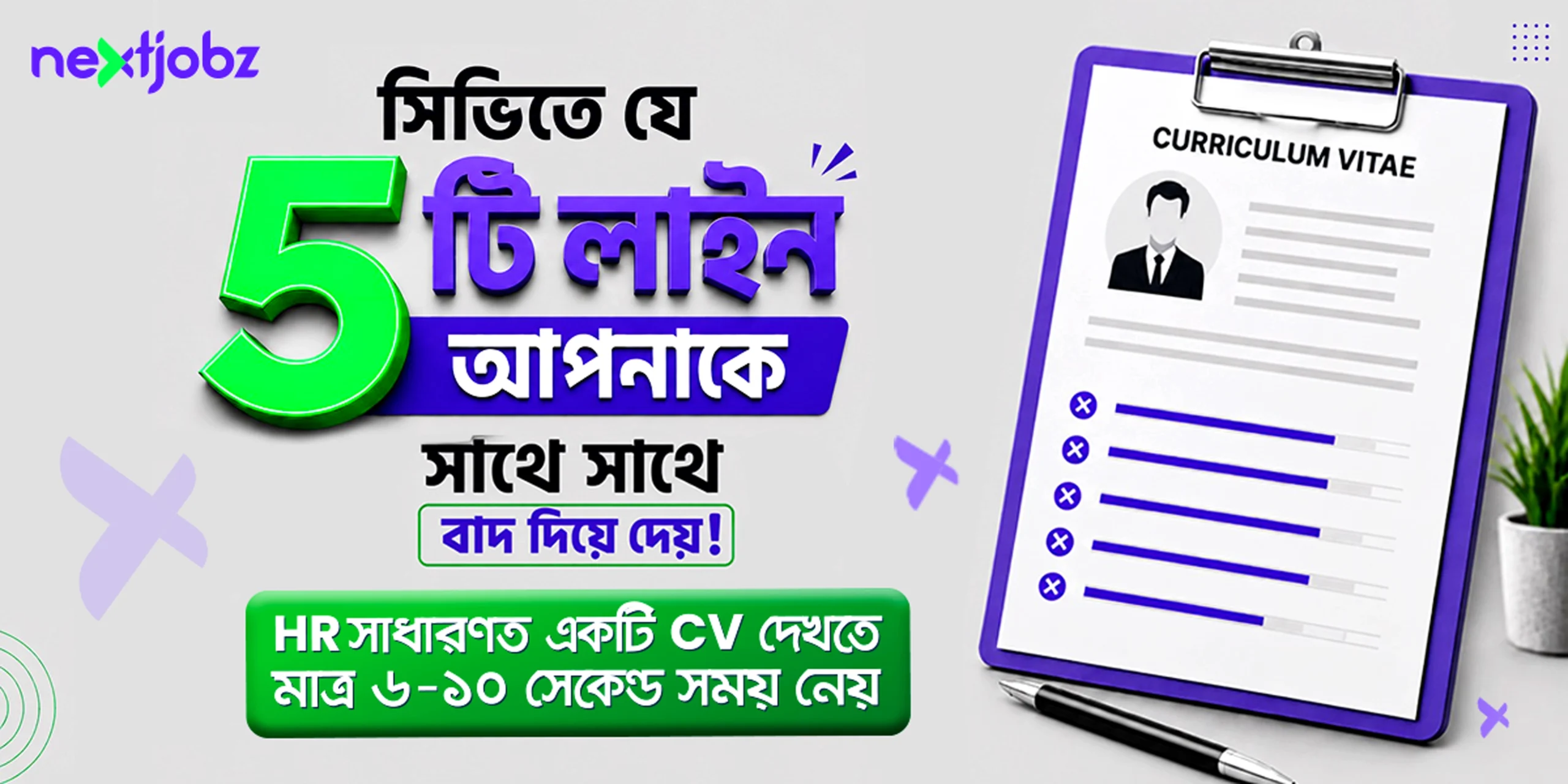
A strong bank job CV format Bangladesh is not about writing more; it is about showing clear value in less time. Recruiters often scan a CV in 6–10 seconds before deciding whether to continue. (Source: Ladders eye-tracking study)
Here are proven, practical tips to improve your chances:
- Quantify Your Work
Avoid generic statements. Numbers make your work real and measurable.
Instead of writing “Handled customers”, write “Handled 60+ daily transactions with 98% accuracy”.
This aligns with hiring trends seen in banks like Bangladesh Bank, where performance-based evaluation is key.
- Follow the 6-Second Rule
Recruiters do not read every word they scan. Use clear headings, bullet points, and proper spacing so key details stand out instantly.
A clean structure increases readability and improves shortlisting chances.
- Use Relevant Keywords (ATS Optimization)
Many banks use ATS Applicant Tracking Systems or structured filtering systems. Include keywords like banking, finance, credit risk, compliance, KYC, AML.
According to LinkedIn hiring insights, keyword-matched CVs are more likely to pass initial screening.
- Show Digital Awareness
Banking in 2026 is highly digital. Mention tools like Core Banking Systems (CBS), Advanced Excel, or financial software.
Basic digital skills are no longer optional, they are expected in both public and private banks.
- Add Strong References
In Bangladesh, references still play a major role in trust-building. Include 1–2 credible referees (academic or professional) with proper contact details.
This is especially important for roles in institutions like Sonali Bank and Islami Bank Bangladesh Limited.
Banking Job Cover Letter Bangladesh (Winning Strategy)
In the Bangladesh banking sector, where HR managers shift through thousands of applications, a generic cover letter is the fastest way to get rejected. A winning banking job cover in Bangladesh must act as a bridge between your academic achievements and the bank’s specific goals.
While many candidates skip it, recruiters in banks like Bangladesh Bank and BRAC Bank often use cover letters to assess communication skills, professionalism, and intent.
According to career guidelines from The Daily Star and multiple bank career portals, a well-written cover letter increases your chances of getting shortlisted especially for entry-level roles.
What Makes a Winning Banking Cover Letter?
- Start with a Clear Purpose
Mention the exact position you are applying for and where you found the job circular. Keep it direct and professional. - Show Why You Fit the Role
Connect your academic background, internship, or work experience with the job requirements. For example, mention finance knowledge, customer handling, or compliance understanding. - Highlight Measurable Value
Even in a cover letter, numbers matter.
Example: “Handled 50+ customer queries daily during internship with high accuracy.” - Demonstrate Knowledge of the Bank
Show that you understand the bank’s services, values, or recent activities. This signals genuine interest, not a generic application. - Keep It Short and Structured
3–4 short paragraphs are enough. Avoid long blocks of text. Recruiters spend very little time per application.
Simple Cover Letter Structure (Recommended)
- Opening Paragraph – Role + interest
- Middle Paragraph – Skills + experience + value
- Closing Paragraph – Confidence + call for interview
Always match your cover letter tone with your CV. If your CV is data-driven, your cover letter should reinforce that with clear and concise points.
A well-crafted cover letter does not repeat your CV; it strengthens it. In Bangladesh’s banking sector, where competition is high, this extra effort often becomes the deciding factor.
Bank Job Exam Preparation Guide (Step-by-Step)
Preparing for a bank job exam in Bangladesh requires a structured approach and deep subject knowledge. Most candidates fail not because of a lack of knowledge, but because they study without a clear plan.
A disciplined step-by-step method improves both speed and accuracy in real exams like those conducted by Bangladesh Bank and leading commercial banks.
Follow this authentic step-by-step roadmap to streamline your efforts.
Step 1: Analyze the “Question Pattern” (The Foundation)
Before buying books, study the last 5–10 years of question papers.
- Government Banks: Usually follow the pattern set by the Arts Faculty (DU), Business Studies Faculty (DU), or BIST. Focus on high-weightage math and analytical English.
- Private Banks: Often use IBA-DU style questions or internal computerized tests that prioritize IQ, logical reasoning, and English vocabulary.
Step 2: Master the High-Yield Subjects
The bank job exam is typically divided into four core pillars. You must master these to crack bank job exam hurdles:
- Mathematics (The Score Booster): Focus on Arithmetic (Profit/Loss, Interest, Percentage) and Geometry. Speed is key; you should solve most problems in under 45 seconds.
- English (The Filter): Focus on Grammar (Analogy, Sentence Correction) and Written English (Focus Writing/Essays).
- General Knowledge & Banking: Stay updated on Bangladesh Bank policies, the National Budget, and global economic shifts.
- ICT & Computer: Basic hardware, networking, and MS Office knowledge (often 10–15 marks).
Step 3: Build a Rigorous Written Strategy
Many candidates pass the MCQ but fail the written exam.
- Translation Practice: Dedicate 30 minutes daily to translating editorial columns from The Daily Star to Prothom Alo and vice versa.
- Focus Writing: Prepare 10–12 “Hot Topics” (e.g., Digital Currency, Blue Economy, Inflation Control) and practice writing 300-word essays in both English and Bengali.
Step 4: The 90-Day “Consistency Loop”
A successful study plan for bank job Bangladesh is built on daily habits:
- Morning (Fresh Mind): Solve 10–15 complex math problems.
- Afternoon (Vocabulary): Read 5–10 new analogies and synonyms.
- Evening (GK/ICT): Review monthly current affairs and take a 100-mark mock MCQ test.
Step 5: Mock Tests & Time Management
The biggest enemy in a bank exam is the clock.
- In a typical bank job MCQ preparation scenario, you have 60 minutes for 100 questions.
- The Strategy: Skip “time-killer” math problems during the first pass. Secure the marks for Bangla, GK, and ICT first, then dedicate the remaining time to Math and English.
Step 6: Post-Exam Analysis
After every mock test or real exam, don’t just look at your score. Analyze why you got questions wrong. Was it a lack of knowledge, a silly mistake, or a time management issue? Correcting these “content gaps” is how you move from a candidate to an officer.
Step 7: Final Viva Polish
If you clear the written, your bank viva preparation in Bangladesh begins.
- Subject Knowledge: Be ready to explain your graduation subject and its relevance to banking.
- Banking Awareness: Know the current CRR (Cash Reserve Ratio), SLR (Statutory Liquidity Ratio), and the name of the current Governor of Bangladesh Bank.
- Attitude: Recruiters look for calm, polite, and logically sound individuals who can handle high-pressure customer environments.
Bank Job Written Exam Syllabus Bangladesh
The written exam is the ultimate testing ground for your analytical depth and creative expression. Unlike the MCQ round, which filters for speed, the written phase evaluates your ability to organize thoughts under pressure.
For any government bank job Bangladesh or top-tier private bank role, the syllabus is broad but predictable.
Common Subjects and Mark Distribution
While the exact marks vary between the Arts Faculty and IBA-DU patterns, most exams follow this core structure:
Subject:
- English Language
- Mathematics
- General Knowledge (GK)
- Banking Knowledge
- Computer & ICT Basics
Structure:
- Mathematics (Focus on Logic): This section usually carries 30–50 marks. You are expected to show the full calculation (not just the answer).
- Key Topics: Arithmetic (Pipe & Cistern, Boat & Stream, Compound Interest), Algebra, and Geometry.
- Pro Tip: Solving 10th-grade “Higher Math” and previous Bangladesh Bank AD questions is the most authentic way to prepare.
- Focus Writing (English & Bengali): Typically 30–40 marks each. You must write an essay on a contemporary economic or social issue.
- 2026 Trending Topics: Digital Banking Security, The Role of Remittance in BD Economy, or Climate Change and Financial Risk.
- Translation (The Bridge): You will be given two passages, one to translate from English to Bengali and another from Bengali to English (15–20 marks each).
- Source Material: Usually taken from international editorials (The Economist) or local business pages (The Business Standard).
- General Knowledge (Analytical): Instead of simple “Who is who,” you may be asked to write short notes on economic terms like “Inflation Control,” “L/C opening,” or “The Fourth Industrial Revolution.”
- Letter Writing/Application: Occasionally, you may need to draft a formal letter to a Branch Manager or a “Letter to the Editor” regarding a specific financial problem.
Banking Exam Question Pattern Bangladesh
To master your bank job exam preparation guide, you must recognize that the “pattern” depends entirely on which academic body is conducting the exam.
In Bangladesh, banking recruitment is not centralized under one single format; instead, different faculties from the University of Dhaka (DU) or specialized institutes design the papers.
Understanding these patterns allows you to adjust your bank job MCQ preparation and written strategies accordingly.
- The Arts Faculty (DU) Pattern
This is the most common pattern for government bank job Bangladesh recruitments (e.g., Sonali, Janata, Agrani).
- MCQ Focus: Strong emphasis on traditional Bengali literature, grammar, and straightforward Arithmetic.
- Written Focus: High-mark allocations for translations and long-form focus writing in both English and Bengali.
- Strategy: If the Arts Faculty is conducting your exam, prioritize “Job Solution” books and classic Bengali literature guides.
- The Business Studies Faculty (DU) Pattern
Frequently used for Bangladesh Bank job preparation (Assistant Director roles) and combined Senior Officer posts.
- MCQ Focus: Heavy on analytical puzzles, critical reasoning, and business-related General Knowledge.
- Written Focus: Math problems are often more complex, requiring multiple steps, and essays usually revolve around macroeconomic themes.
- Strategy: Practice GRE-style math and stay updated on the latest Bangladesh Bank circulars and monetary policies.
3. The IBA-DU Pattern
This is the “Gold Standard” for private bank job in Bangladesh recruitment, especially for Management Trainee Officer (MTO) positions.
- MCQ Focus: Notorious for difficult English (Sentence Correction, Analogies, and Reading Comprehension) and high-speed Math.
- Written Focus: Often includes short, punchy business cases or argumentative essays where logical flow is more important than length.
- Strategy: Use Barron’s SAT or GRE guides to prepare for the English and Analytical sections.
4. The BIST (Bangladesh Institute of Bank Management) Pattern
Sometimes used for specialized or technical banking roles.
- Focus: This pattern leans heavily toward Banking & Finance specific knowledge, ICT, and recent digital banking trends in 2026.
Typical Mark Distribution (General Overview)
| Section | MCQ (Preliminary) | Written (Main) |
| Mathematics | 20–25 Marks | 30–50 Marks |
| English | 20 Marks | 40–60 Marks (Essays/Translation) |
| Bengali | 20 Marks | 20–30 Marks |
| General Knowledge | 15–20 Marks | 10–20 Marks (Short Notes) |
| ICT / Computer | 10–15 Marks | Included in GK or separate |
| Analytical Ability | 10 Marks | Occasionally included |
2026 Market Insight: In current banking exam question patterns in Bangladesh, almost 15% of the total marks are now dedicated to digital literacy. Whether it’s MCQ or Written, expect questions on Cyber Security, Fintech (bKash/Nagad), and Cloud Computing.
Bank Job MCQ Preparation Strategy
The Preliminary MCQ test is the most significant rejection filter in the Bangladesh banking recruitment process.
According to successful candidates and experts from the 2026 recruitment cycle, passing this stage requires a transition from general reading to a highly calculated, exam-oriented approach.
- The “60-Minute” Reality Check
Most bank exams in Bangladesh (especially those by the Arts Faculty or BBSC) allot 60 minutes for 100 questions. This means you have exactly 36 seconds per question, including the time to fill in the OMR sheet.
- The Strategy: Do not read chronologically. Start with General Knowledge, Bengali, and ICT. These are “hit or miss” questions that should take no more than 10–15 seconds each. Save the remaining 40+ minutes for Math and English.
- Strategic Guesswork & Negative Marking
Almost all modern bank exams in Bangladesh carry a negative marking of 0.25 for every wrong answer.
- The Strategy: Use the Rule of Elimination. If you can confidently eliminate two out of four options, it is statistically worth taking the risk. If you have no idea about the question, skip it immediately. A “no-mark” is better than a “minus-mark.”
- Subject-Specific Shortcuts
To crack bank job exam preliminary rounds, you must use shortcuts that bypass traditional long-form calculations.
- Math: Memorize squares up to 30, cubes up to 15, and fractional equivalents (e.g., 12.5% = 1/8). Use “Option Testing” (plugging the given answers back into the question) to solve algebra and age-related problems faster.
- English: Focus on Analogies and Sentence Correction. These are the highest-weightage areas in IBA-DU and Bangladesh Bank patterns.
- ICT: 2026 trends show a heavy focus on Cyber Security and FinTech terms. Ensure you know the latest digital banking protocols used in Bangladesh.
4. The “90-Day Master Plan” Loop
Authentic preparation guides for 2026 suggest a cyclical study method:
- Phase 1 (Day 1–30): Foundation building. Solve every math problem from the Class 9-10 General Math book.
- Phase 2 (Day 31–60): Past paper analysis. Solve the last 5 years of Combined Bank and Bangladesh Bank AD questions.
- Phase 3 (Day 61–90): Daily Mock Tests. Take at least one full-length 100-mark exam daily to stabilize your “exam nerves.”
Study Plan for Bank Job Bangladesh (30/60/90 Days)
Success in the 2026 banking recruitment cycle is not about studying more; it is about studying with a schedule.
Whether you are aiming for Bangladesh Bank job preparation or a Combined Senior Officer role, this 90-day master plan ensures you cover the entire syllabus while leaving room for revision.
Phase 1: The Foundation (Day 1–30)
The first month is about clearing your basics. You cannot build speed if your fundamental concepts are weak.
- Mathematics: Complete the Class 9-10 General Math book. Focus on Arithmetic (Profit-Loss, Percentage, Interest).
- English: Master grammar basics (Parts of Speech, Tense, Voice) and start memorizing 10 new Analogies and Idioms daily.
- Bengali: Read the Class 9-10 Board Grammar book and familiarize yourself with the major poets (Tagore, Nazrul).
- GK & ICT: Start reading a daily newspaper (The Daily Star or Prothom Alo) for 30 minutes. Learn basic computer hardware and shortcut keys.
Phase 2: In-Depth Analysis (Day 31–60)
Now that your basics are clear, move to competitive-level materials and previous question patterns.
- Mathematics: Move to Khairul’s Basic Math or SaifuR’s Math. Practice Geometry and Algebra problems that frequently appear in Arts Faculty or IBA-DU exams.
- English: Start “Focus Writing” practice. Write 300 words daily on topics like Digital Currency or Inflation Control. Use Barron’s TOEFL for sentence correction.
- GK & Banking: Study the last 12 months of Current Affairs. Focus specifically on the Bangladesh Bank monetary policy, the National Budget, and international financial institutions (IMF, World Bank).
- Previous Papers: Solve the last 5 years of Combined Bank Senior Officer and Officer Cash questions to understand the “rhythm” of the exam.
Phase 3: The Polish & Mock Stage (Day 61–90)
The final month is for speed, accuracy, and mental stamina.
- Mathematics: Practice solving math problems without a calculator. Aim to solve 20 problems in 15 minutes.
- Written Preparation: Focus on translations. Practice converting complex editorial passages from English to Bengali and vice-versa every single day.
- Daily Mock Tests: Take one full-length 100-mark MCQ test every morning. Spend the evening analyzing your mistakes.
- Revision: Do not read new books. Review your notes on bank job MCQ preparation and your formula sheet for math.
Daily Routine Breakdown for 2026
To stay consistent, follow this high-intensity daily schedule:
| Time Slot | Subject Focus | Goal |
| 07:00 AM – 09:00 AM | Mathematics | Solve 15–20 complex problems. |
| 10:00 AM – 11:30 AM | English Vocabulary | Analogies, Synonyms, and Idioms. |
| 02:00 PM – 03:30 PM | GK & Newspaper | Focus on Business and International pages. |
| 05:00 PM – 06:30 PM | Bengali & ICT | Literature and Computer hardware basics. |
| 08:30 PM – 10:00 PM | Focus Writing | Write one essay (English/Bengali). |
| 10:30 PM – 11:30 PM | Mock Test | 100 MCQs in 60 minutes. |
For a successful study plan for bank job Bangladesh, consistency is more important than intensity. Even if you are busy, ensure you solve at least 5 math problems and read 5 new English words every day to keep your brain in “exam mode.”
Best Books for Bank Job Preparation
Choosing the right study materials is 50% of the battle. In the 2026 recruitment cycle, the syllabus has shifted towards more analytical and ICT-based questions. To outrank other candidates, you need a mix of subject-specific textbooks and recent “Job Solution” banks.
1. Mathematics (The Deciding Factor)
Math is often the highest-weightage section and requires both speed and conceptual clarity.
- Foundation: Class 9-10 General Math Board Book (Essential for basic arithmetic and geometry).
- Competitive Level: Khairul’s Bank Math or Phenom’s Bank Math Bible (3rd Edition, 2025/26). These are highly regarded for their topic-wise organization and shortcut methods.
- Analytical/IBA Pattern: SaifuR’s Math (IBA & Bank) or Barron’s SAT Math for high-difficulty private bank exams.
2. English (The Selection Filter)
Success in English requires a strong vocabulary and a firm grasp of grammar.
- Grammar: Barron’s TOEFL (for sentence correction and structure) and Secondary Basic English Grammar.
- Vocabulary: S.M. Zakir Hussain’s Passage to English and English For Competitive Exams by Fazlul Haque.
- Analytical English: GRE Big Book (specifically for Analogies and Reading Comprehension).
3. Bengali (Literature & Grammar)
- Grammar: Class 9-10 Board Grammar Book (The “Holy Grail” for Bengali grammar).
- Literature: Agradut Bangla by Mofizul Islam Milon or Expert Literature. These books cover the essential poets and writers frequently asked about in Arts Faculty exams.
4. General Knowledge & ICT
- General Knowledge: MP3 Bangladesh & International Affairs by George’s. For real-time updates, follow Monthly Current Affairs or Alokbortika’s Monthly PDF.
- Banking Knowledge: Foundations of Economics: Basic & Viva by S.M. Moinul Hasan.
- ICT: Computer & ICT by Cell (Commonly used for both BCS and Bank prep).
5. Job Solutions (Previous Years’ Questions)
To understand the banking exam question pattern in Bangladesh, you must solve past papers.
- Combined/Govt Banks: Professor’s Recent Bank Job Solution (2026 Edition) or Matrix Bank Job Solution (Topic-wise).
- Specialized Banks: Eminent Bangladesh Bank Recruitment Guide (specifically for AD and Senior Officer roles).
- Private Banks: Key to Private Bank Job by Professor’s or 4-in-1 Bank Solution (Arts, FBS, BIBM, IBA).
Essential Booklist Summary Table
| Subject | Recommended Book | Why it’s Essential |
| Mathematics | Khairul’s Bank Math | Covers almost all types of bank math with shortcuts. |
| English | Barron’s TOEFL | Best for error detection and grammar rules. |
| Bengali | Agradut Bangla | Excellent for synonyms, antonyms, and literature. |
| GK | MP3 Bangladesh | Comprehensive for history and geography. |
| Job Solution | Professor’s Recent | Essential for practicing actual exam questions from 2025-26. |
Bank Viva Preparation Bangladesh
Passing the written exam proves your merit, but the viva (interview) is where the board assesses your personality, presence, and professional fit. In the 2026 banking landscape, viva boards are looking for candidates who aren’t just “book smart” but are also ethically grounded and technologically aware.
- Master the “Introduction”
Your first 90 seconds often set the tone for the entire interview.
- The Strategy: Prepare a concise (1-minute) introduction in both English and Bengali. Mention your name, hometown, educational background, and a unique achievement or interest.
- Pro Tip: Avoid reciting your CV. Instead, highlight why your background makes you a great fit for a banking career.
- Know Your Core Subjects
Regardless of your major (CSE, Finance, or Arts), the board will test your academic foundation.
- For Non-Business Students: Be ready to answer “How will your subject help the bank?” (e.g., “As a CSE graduate, I can contribute to the bank’s digital security and FinTech operations.”).
- For Business Students: Expect deep questions on Monetary Policy, Basel III, NPL management, and Accounting principles.
- Current Banking & Economic Awareness
You must show that you are connected to the reality of the Bangladesh market.
- Must-Know Data: Current GDP growth, Inflation rate, Foreign Exchange Reserves, and the name of the Governor of Bangladesh Bank.
- Recent Trends: Be prepared to discuss Universal Pension Schemes, the impact of the Dollar crisis, or the growth of Mobile Financial Services (MFS) like bKash and Nagad.
- Situational & Ethical Questions
The board often presents “What if” scenarios to test your integrity and stress management.
- Common Scenario: “If your relative asks for a loan without proper documents, what will you do?”
- Correct Approach: Always prioritize the Bank’s Policy and Regulatory Compliance over personal relationships. Your answer should reflect logic and professional ethics.
Viva Day Checklist: Dress & Etiquette
A banker must look the part. Professionalism starts with your appearance and manners.
| Category | For Male Candidates | For Female Candidates |
| Attire | Full-sleeve light-colored shirt, dark tie, and formal trousers. | Modest Saree or Salwar Kameez in neutral/sober colors. |
| Footwear | Polished black or brown formal shoes. | Formal flat shoes or low heels (avoid noisy sandals). |
| Body Language | Maintain an upright posture and eye contact. | Sit confidently and maintain a pleasant expression. |
| Etiquette | Knock before entering, greet with a smile, and wait for permission to sit. | Same as male; avoid excessive jewelry or strong perfumes. |
Tips for the Interview Success
- The “Honest” Rule: If you don’t know an answer, politely say, “I am sorry, sir/ma’am, I am not aware of this at the moment, but I will look it up.” Never try to bluff the board.
- Stay Calm: If the board becomes “aggressive,” it is often a stress test. Stay polite and don’t lose your temper.
- Practice Mock Vivas: Record yourself or practice with friends to identify and fix nervous habits like fidgeting or filler words (“um,” “uh”).
Tips to Pass Bank Job Exams & Get Selected
Passing a bank exam in Bangladesh is a test of both endurance and strategy. With thousands of candidates fighting for a single seat, the difference between success and failure often lies in small, disciplined habits.
Here are the most effective, authentic tips from top performers in the 2026 recruitment cycle.
1. Master the “Art of Skipping”
The biggest mistake candidates make is getting stuck on a difficult math problem. In a 60-minute MCQ test, every second counts.
- The Strategy: If you cannot find the logic for a math problem or an analytical puzzle within 20 seconds, skip it. Mark the easy questions first to secure a baseline score. You can always come back to the tough ones if time permits.
2. Focus on “High-Frequency” Topics
Don’t try to learn everything. Analyze the banking exam question pattern in Bangladesh to identify topics that appear every year.
- Math: Percentage, Profit & Loss, and Pipe & Cistern.
- English: Subject-Verb Agreement, Analogy, and Appropriate Prepositions.
- Bengali: Synonyms, spelling, and works of the “Big Five” poets.
3. Build “Contextual” General Knowledge
Instead of memorizing random facts, focus on GK that relates to the banking sector.
- Bangladesh Economy: Keep a “data sheet” of the current GDP growth rate, inflation rate, and total remittance.
- Digital Trends: Be ready for questions on Real-Time Gross Settlement (RTGS), Electronic Funds Transfer (BEFTN), and the latest cybersecurity measures taken by Bangladesh Bank.
4. Practice “Focus Writing” Under Pressure
The written exam is where most candidates fail due to poor time management.
- The Tip: Set a timer for 20 minutes and try to write two pages on a current economic topic (e.g., “The Impact of Artificial Intelligence on Banking”). Focus on clear handwriting, logical paragraphs, and using data to back your arguments.
5. Join a “Quality” Study Circle
Banking preparation can be lonely and exhausting.
- The Tip: Join a small group (3–4 people) of serious candidates. Discussing complex math shortcuts or sharing recent GK updates helps reinforce your memory. Online platforms and dedicated Facebook groups for bank job preparation Bangladesh are also excellent for staying updated on circulars and seat plans.
6. The “24-Hour” Revision Rule
Information fades quickly.
- The Tip: Whatever you study today, review it briefly for 15 minutes the next morning. This “Spaced Repetition” technique is proven to move information from short-term to long-term memory.
- Dress and Act Like a Banker (Viva Prep)
If you reach the viva stage, the board is looking for “Cultural Fit.”
- The Tip: Wear clean, formal attire. Practice your “Introduction” in front of a mirror. When asked a question you don’t know, stay calm and politely admit it rather than guessing. Honesty and composure are core skills required for banking jobs.
Banking Career Roadmap Bangladesh (Beginner to Officer)
The banking sector remains one of the most structured and prestigious career paths in Bangladesh. In 2026, the transition from a fresh graduate to a bank officer is governed by specific “entry tracks” and a newly updated regulatory framework by Bangladesh Bank.
- The Entry Points (Beginner Level)
There are two primary ways to enter a bank as a beginner, depending on the sector:
- Management Trainee Officer (MTO) / Probationary Officer:
- Sector: Primarily Private Commercial Banks (PCBs) and Foreign Banks.
- Role: This is a “fast-track” leadership program. Candidates spend 1 year as a Trainee/Probationer and are then promoted to Senior Officer or Assistant Manager.
- Requirement: High CGPA (usually 3.00+) and excellence in analytical exams (IBA-DU pattern).
- Officer / Senior Officer (General):
- Sector: State-owned Commercial Banks (SCBs) and specialized banks.
- Role: Entry-level administrative and operational roles.
- Requirement: Recruitment through the Bankers’ Selection Committee (BSC) based on the National Pay Scale.
- The Professional Hierarchy (The Ladder)
Once you are appointed as an officer, the career path follows a clear upward trajectory. In 2026, the hierarchy is generally divided into three tiers:
Tier 1: Junior & Mid-Management
- Management Trainee (MTO) / Trainee Officer (Entry)
- Officer / Senior Officer (Year 1–3)
- Principal Officer (PO) (Year 4–7)
- Senior Principal Officer (SPO) (Year 8–10)
Tier 2: Senior Management
- Assistant General Manager (AGM) / Assistant Vice President (AVP)
- Deputy General Manager (DGM) / Vice President (VP)
- General Manager (GM) / Senior Vice President (SVP)
Tier 3: Executive Leadership
- Executive Director / Executive Vice President (EVP)
- Deputy Managing Director (DMD)
- Additional Managing Director (AMD)
- Managing Director (MD) & CEO
- The 2026 “Banking Diploma” Mandate
A critical update for anyone starting their roadmap in 2026 is that Bangladesh Bank has made the Banking Diploma (JAIBB & AIBB) mandatory for promotion to any higher position.
- The Rule: Effective from January 2026, you cannot move up the ladder unless you pass these professional examinations conducted by the Institute of Bankers, Bangladesh (IBB).
- Exemption: Only officers with 15+ years of experience at the Senior Officer level are exempt.
- Career Advancement Strategy
To move through this roadmap efficiently, focus on these three pillars:
- Performance Appraisal (ACR): Your “Annual Confidential Report” holds 70% weight in promotion decisions. Meeting deposit, recovery, and account opening targets is essential.
- Academic & Professional Qualifications: Having an MBA or a professional certification in Credit Risk Management or Trade Finance adds significant points (up to 20%) to your promotion score.
- Digital Adaptability: In 2026, banks are prioritizing officers who can manage AI-driven CRM and Cybersecurity protocols.
Comparison of Career Pace
| Feature | Private Bank (MTO Track) | Government Bank (General Track) |
| Promotion Speed | Fast (Performance-based) | Slow to Moderate (Seniority-based) |
| Salary Growth | High (High starting + Performance bonus) | Moderate (Fixed Pay Scale + Gratuity) |
| Stability | Performance-dependent | Extremely Secure |
How to Get Your First Bank Job Fast
In the high-stakes recruitment cycle of 2026, landing your first bank job requires a shift from “waiting for circulars” to “proactive preparation.” While public sector roles offer stability, private banks provide the fastest entry for ambitious freshers.
- The “Fastest Track”: Private Bank MTO Programs
Management Trainee Officer (MTO) or “NextGen Leader” programs are the quickest way to enter the banking sector. Unlike government banks, which can take 12–18 months to finalize recruitment, top-tier private banks (like Bank Asia, AB Bank, or City Bank) often complete the entire process from circular to joining in 3 to 4 months.
- The 2026 Competitive Edge: Banks like Bank Asia PLC now explicitly look for candidates who can use AI-based tools for productivity. Highlighting your digital literacy in your CV can fast-track your shortlisting.
- The Salary Hook: Starting salaries for MTOs in 2026 are highly competitive, with some banks offering up to BDT 75,000 during the trainee period and BDT 90,000+ upon confirmation.
- Optimize Your “eRecruitment” Profile
For government roles, the Bangladesh Bank eRecruitment portal is your gateway. To avoid missing out:
- Pre-Verify Everything: Don’t wait for a circular to upload your certificates. Keep your CV, photo, and signature updated on the official portal.
- Stay Alert: Check the “Circular” section weekly. In 2026, Assistant Director (AD) and Senior Officer roles often have tight application deadlines (usually 3–4 weeks).
- Master the “High-Speed” Skill Set
To get hired fast, you must be ready to pass the exam the moment a circular drops.
- Focus on the “Big Three”: 80% of the MCQ marks come from Mathematics, English, and Analytical Ability. If you can solve these with 90% accuracy, you are already ahead of 95% of candidates.
- Digital Tools: Proficiency in MS Excel and basic knowledge of Core Banking Systems (CBS) and Cybersecurity are not “optional” they are mandatory for passing the screening phase.
- Networking & Social Proof
In the 2026 market, “Who you know” helps, but “Who knows you” is better.
- LinkedIn Presence: Follow the HR Heads and Talent Acquisition managers of top banks. Engaging with their posts on Digital Banking or Financial Inclusion makes your name familiar when your CV hits their desk.
- Professional CV: Ensure your CV is ATS-friendly. Use keywords like KYC Compliance, Credit Risk, Trade Finance, and Customer Relationship Management (CRM) to pass automated filters.
Final Verdict – Get a Bank Job in Bangladesh
In the 2026 job market, a Banking Career in Bangladesh remains a top-tier choice for stability and growth, but the entry barrier has shifted toward analytical agility. Success is no longer determined solely by your CGPA; it is defined by your performance in competitive written exams and your readiness to adapt to a digital-first banking environment.
To secure a position, you must master high-speed mathematical shortcuts and demonstrate a deep understanding of current macroeconomic trends.
The most effective path to selection involves a disciplined 90-day study plan tailored to the specific question patterns of major recruiting bodies. By focusing on ICT literacy, data-backed storytelling, and English proficiency, you can move from a candidate to a bank officer.
Some Common FAQs – Bank Job in Bangladesh
1. How hard is it to get a bank job in Bangladesh?
It is highly competitive. While the national unemployment rate is low, graduate unemployment sits at approximately 13.5% in 2026. Banks have shifted toward skill-based hiring, prioritizing candidates with practical digital literacy (Advanced Excel, Data Analytics) over mere degree holders. For high-demand roles like Bangladesh Bank AD, thousands of applicants compete for very few seats, making the written and viva stages extremely rigorous.
2. Which bank job is best in Bangladesh?
The “best” job depends on your goals:
- Bangladesh Bank (Assistant Director): Best for prestige, long-term security, and policy-making influence.
- Private Banks (MTO/Probationary Officer): BRAC Bank, Prime Bank, and Standard Chartered are often ranked top for their corporate culture, fast-track promotions, and high starting salaries.
- State-Owned Banks (Senior Officer): Best for job security and pension benefits under the National Pay Scale.
3. Can fresh graduates apply for bank jobs?
Yes. Most banks have dedicated entry-level tracks specifically for freshers. Common roles include:
- Management Trainee Officer (MTO)
- Probationary Officer / Trainee Officer
- Internships
4. What is the salary of bank jobs in Bangladesh?
As of 2026, salaries have seen an upward trend due to inflation adjustments:
- Private Banks (Entry Level): Starting salaries for MTOs range from BDT 50,000 to BDT 90,000, while Trainee Officers earn between BDT 25,000 and BDT 45,000.
- Government Banks: Salaries follow the National Pay Scale. A Senior Officer (Grade-7) starts with a basic of BDT 29,000, which totals roughly BDT 45,000–50,000 including allowances.
- Proposed 9th Pay Scale: A new structure is under review that could potentially double these basic figures in the near future.
5. How long does bank job preparation take?
For a dedicated candidate, a 90-day (3-month) intensive crash course is typically sufficient to cover the core syllabus (Math, English, GK, and ICT). However, because of the unpredictable nature of circulars and the high volume of content, many successful applicants spend 6 months to 1 year in consistent preparation to master the accuracy and speed required for the MCQ rounds.