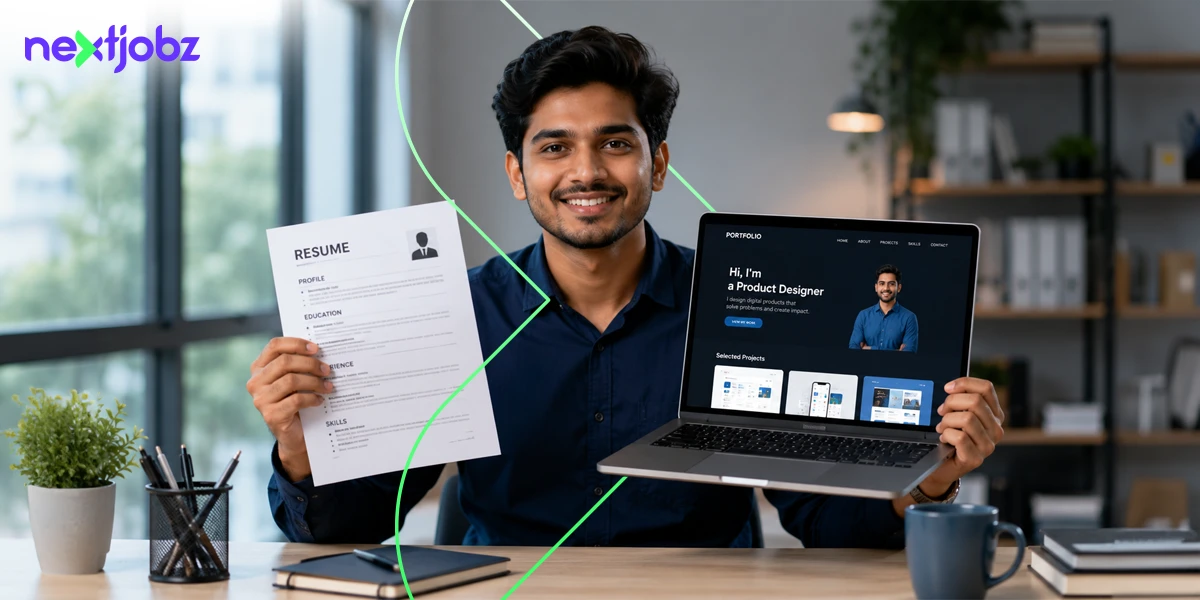
A resume tells employers what you have done. A portfolio shows them proof that you can do it. Both are needed in most job applications in 2026, but they do different jobs. A resume gets you through the first filter, often an ATS system, and into the hands of a recruiter. A portfolio is what convinces the hiring manager after that first filter. Recruiters now spend an average of 6 to 7 seconds scanning a resume. A portfolio keeps them engaged for minutes at a time. Understanding the competition between a portfolio vs resume has become much more complex today for job seekers, especially for rookies. Thus, nextjobz explains the exact difference between a portfolio and a resume, shows you which one you need for your field in Bangladesh, provides a step-by-step framework for building a digital portfolio from scratch for free, and explains how to connect both documents so they work together as one application.
Portfolio vs Resume: What Is Actually Different
A resume is a short summary document that tells a recruiter what you have done and where you have worked. A portfolio is a collection of actual work samples that shows them what you can produce. One describes. The other proves.
The clearest way to understand the difference is to think about what each document answers.
| Question | Resume Answers It | Portfolio Answers It |
| Where have you worked? | Yes, lists every employer and role | No, not the primary purpose |
| What do you claim to be good at? | Yes, skills section and bullet points | No, but proves the claims with real examples |
| Can you actually do the work? | Not directly, only implies it | Yes, shows real projects and real outcomes |
| How do you think about problems? | No, too short for context | Yes, case studies show your process |
| What is the quality of your output? | No, only describes it in words | Yes, the work itself is visible |
| Does your profile pass ATS screening? | Yes, designed to do exactly this | No, portfolios are for human reviewers |
As CareerAddict’s 2026 analysis explains, a resume says what you can do and a portfolio proves it.
Recruiters now spend an average of just 6 to 7 seconds scanning a resume before deciding whether to read more.
A portfolio keeps them engaged far longer because they are looking at real work, not just words about work.
The differences among a CV, a resume, and a portfolio are also worth clarifying, as many Bangladeshi job seekers use these terms interchangeably.
A CV (curriculum vitae) is a long-form document used in academic and research contexts that lists everything, including publications, research, and awards, with no page limit.
A resume is a short one- to two-page document tailored to a specific job in the private sector. A portfolio is a separate collection of work samples that accompanies either document.
Do You Actually Need a Portfolio? A Decision Framework, Not a Generic Answer
Whether you need a portfolio depends on your role and industry. Creative, technical, and project-based roles almost always require one. Administrative and compliance-heavy roles often do not. Most Bangladeshi job seekers in 2026 benefit from having both.
Roles and Industries in Bangladesh Where a Portfolio Is Expected
Graphic designers, software developers, digital marketers, content writers, architects, UX designers, video editors, and photographers are all expected to show a portfolio in Bangladesh. Applying without one in these fields puts you at a serious disadvantage.
| Field | What the Portfolio Should Show |
| Graphic design | Logos, branding projects, print and digital materials with before-and-after context |
| Software development | GitHub repositories, live deployed projects, code samples with documentation |
| Digital marketing | Campaign results with metrics, social media growth data, content performance reports |
| Content writing and journalism | Published articles, blog posts, long-form pieces with engagement data if available |
| UX and UI design | Full case studies showing user research, wireframes, prototypes, and final screens |
| Architecture and interior design | Project drawings, 3D renders, completed project photos with brief descriptions |
| Video production and editing | Showreel, individual project clips with production notes |
| Photography | Curated gallery organized by category with a brief description of each shoot |
Roles Where a Resume Alone Is Still Enough
Accounting, finance, HR, supply chain, government administration, and compliance roles in Bangladesh still rely primarily on resumes and cover letters. A portfolio is a bonus in these fields but is not expected by most recruiters.
If you work in accounting, finance, government administration, HR operations, or supply chain, a strong resume with clear results and a well-written cover letter is still the main document that gets you hired.
That said, even in these fields, a simple one-page personal website with a brief bio and a link to your resume is increasingly common and can separate you from equally qualified candidates.
The Both Default: Why Most Bangladeshi Job Seekers Should Build Both
In a competitive job market where many candidates have similar degrees and similar work experience, a portfolio gives you a way to show something that cannot be faked or inflated: actual work with actual results.
According to ValidCollege’s 2026 portfolio vs resume analysis, a good resume can get you shortlisted, but a strong portfolio can get you hired.
In Bangladesh’s increasingly competitive private sector, where hundreds of candidates apply for the same role, the combination of a clean ATS-passing resume plus a visible portfolio is becoming the most effective application strategy.
What Proving Your Professional Value Actually Means
Proving your professional value means showing a recruiter or hiring manager a specific problem you solved, how you solved it, and what measurable result it produced. That is different from claiming you have skills.
The Claim to Proof Framework
Every claim on your resume should have a corresponding proof in your portfolio. The claim is the skill or achievement. The proof is the work sample, result, or case study that shows it actually happened.
Your resume might say increased social media engagement by 40%. That is a claim. Your portfolio entry for that same project should show the before-and-after analytics screenshot, describe what campaign you ran, and explain what changed and why. That is proof. Proof converts skeptical recruiters into interested ones.
The Problem to Solution to Result Structure for Each Project
Every project in your portfolio should follow a three-part structure: what problem existed before you started, what you did to address it, and what measurable result your work produced.
This structure works for every field. A software developer describes the bug or missing feature, the code solution they built, and the number of users it helped or the time it saved.
A content writer describes the brand’s weak online presence, the content strategy they built, and the resulting increase in traffic or engagement.
A teacher turned L&D professional describes the training gap they identified, the module they designed, and the improvement in assessment scores after delivery.
Template to fill in for every portfolio project
The problem was [specific issue].
I addressed it by [specific action].
The result was [measurable outcome with a number].
Quantify, or It Does Not Count
A portfolio entry without a number is still just a claim. Attach a percentage, a timeframe, a count of users, a revenue figure, or any specific measurement to every project you include. That number is what makes the proof credible.
If you reduced the delivery time by how many days or by what percentage? If you grew a social media account, from how many followers to how many?
If you trained staff, how many people were trained, and what was the improvement in assessment?
If you built an app, how many users downloaded it? Every project in your portfolio needs at least one number. Without it, the recruiter has no way to judge the scale or impact of your work.
How to Build a Digital Portfolio That Proves Value
Building a digital portfolio does not require a web developer, a paid subscription, or advanced design skills. Several free platforms let you create a professional online portfolio in under two hours with no coding required.
Free and Low-Cost Platforms for Bangladeshi Job Seekers
The best free portfolio platforms for Bangladeshi job seekers in 2026 are GitHub Pages for developers, Behance for designers and creatives, Notion for knowledge workers and writers, Wix for multi-field professionals, and Google Sites for anyone who wants the simplest possible start.
| Platform | Best For | Cost | Coding Needed | Bangladesh Accessible |
| GitHub Pages | Software developers and data professionals | Free with GitHub account | Yes, basic HTML or Markdown | Yes |
| Behance | Graphic designers, photographers, videographers | Free | No | Yes |
| Notion | Writers, researchers, consultants, L&D professionals | Free for personal use | No | Yes |
| Google Sites | Any field, beginners, simple one-page portfolio | Completely free | No | Yes |
| Wix | Multi-field professionals who want more design control | Free tier available, ads shown | No | Yes |
| Carrd | Simple one-page personal portfolio site | Free tier available, paid from USD 9 per year | No | Yes |
| Read.cv | Clean minimal profile with project links | Free | No | Yes |
Platform comparison data sourced from Sellfy’s 2026 free portfolio website rankings and confirmed against Seera’s tested and ranked portfolio builder guide.
For most Bangladeshi job seekers with no coding background, Google Sites or Notion offers the fastest path to a live portfolio with zero cost.
The Minimum Viable Portfolio: 4 Things Every Version Needs
A minimum viable portfolio needs four elements: a short professional bio, two to four project entries using the problem-solution-result structure, a skills summary that matches your resume, and clear contact information with a link to your LinkedIn or resume.
- Professional Bio: A 3-to-5 sentence summary defining who you are, what you offer, and your target roles.
- Project Case Studies: Feature two to four projects using the problem-solution-result framework. Quality outweighs quantity; ensure each entry highlights a specific, data-backed outcome.
- Skills Summary: List skills that mirror your resume to ensure both documents reinforce your core strengths.
- Clear Contact Info: Provide your email, phone number, LinkedIn URL, and a direct link to your downloadable resume.
Freelance Marketplace Profiles as a Portfolio Alternative
For Bangladeshi freelancers, an active Fiverr, Upwork, or Freelancer profile with completed orders and client reviews already functions as a portfolio. Link it directly from your resume and explain your ratings and review count in your cover letter.
Bangladesh has over one million active freelancers, and many of them already have a track record on freelance platforms.
If you have completed 10 or more projects on Fiverr or Upwork with positive reviews, that profile is your portfolio. You do not need to rebuild it elsewhere.
You need to present it correctly in your job applications by linking to it from your resume and summarizing your top project results in your cover letter.
Linking Your Portfolio and Resume Together
Your portfolio and resume should point to each other. Your resume should carry your portfolio link in the header. Your portfolio should include a downloadable link to your resume. Together they create a complete picture that neither document can create alone.
Where to Place Your Portfolio Link on Your Resume
Place your portfolio link in the contact information section at the top of your resume, directly beside your email and LinkedIn URL. It should be one clean hyperlinked URL that opens directly to your best work.
If you are not sure how to format that section of your resume correctly for ATS screening, learning ATS resume format lets you get to know exactly where each element belongs and how to structure the header so both human readers and ATS systems can process it correctly.
The portfolio link should be short and clean. If your URL is long, use a free link shortener like Bitly or create a custom link using your name.
A link that reads yourname.com or yourname.notion.site is professional and easy to remember. A link with 40 random characters tells the recruiter nothing and may be skipped.
Tailoring Your Portfolio to Match Each Application
Just as you tailor your resume to each job, you should tailor which portfolio projects you highlight for each application. Lead with the projects that most closely match the skills and deliverables described in the job posting.
You do not need to rebuild your portfolio for every application. But you can create a simple pinned or featured project section on most platforms that lets you reorder which projects appear first.
Before you apply for any role, check your portfolio and move the most relevant project to the top. This takes two minutes and noticeably improves how well your application lands.
If you are making a career change at the same time as building your portfolio, career change cover letters explain how to frame projects from a different industry as transferable evidence for a new field, which is the same reframing logic that applies to portfolio project selection.
Portfolio Mistakes That Undermine Your Professional Value
The most common portfolio mistakes are including too many weak projects, writing descriptions without any numbers or outcomes, having a portfolio that loads slowly or looks broken on mobile, and failing to connect the portfolio to the resume so recruiters can find it.
- Quantity over quality: Including every project you’ve ever touched dilutes your impact. Stick to your top two to four most relevant pieces.
- Missing metrics: Describing your actions without including outcomes or data-backed results makes your work forgettable.
- Poor mobile performance: Many recruiters in Bangladesh view links on mobile. If your portfolio is slow or breaks on a phone, you lose the opportunity.
- Unprofessional links: Avoid long, messy URLs. Use a clean, branded link that is easy to share and professional in appearance.
- Stale content: Failing to update your work makes you look stagnant. Refresh your portfolio after every new project.
- No resume link: Always include a direct, downloadable link to your formal resume so recruiters can easily access your full application.
- Missing contact details: A stunning portfolio is useless if an employer has no clear way to reach you. Always include your contact information.
Quick Decision Checklist
Use this checklist before you submit any job application in Bangladesh to ensure your resume and portfolio work together effectively.
- ATS-Ready Resume: Ensure your resume is keyword-optimized and fits within one or two pages.
- Proof-Driven Portfolio: Feature 2–4 projects using the problem-solution-result structure, with at least one measurable number for each.
- Seamless Integration: Place your portfolio link in the contact section at the top of your resume.
- Accessibility: Include a direct, downloadable link to your resume within your portfolio.
- Role-Specific Customization: Reorder your portfolio projects so the most relevant example appears first.
- Technical Readiness: Verify that your portfolio is mobile-responsive and all links are active.
- Unified Branding: Ensure the skills section in your portfolio perfectly matches the skills listed on your resume.
- Clear Contact Info: Confirm that your contact details are up to date, professional, and easy to find.
Frequently Asked Questions on Portfolio Vs. Resume
Can a portfolio replace a resume?
No. A portfolio cannot replace a resume because ATS systems that screen applications only read resume documents, not portfolio websites. You need both working together.
What is the difference between a CV, resume, and portfolio?
A CV is a long academic document with no page limit. A resume is a short one- to two-page job application document. A portfolio is a separate collection of actual work samples that supports either document.
Do I need a digital portfolio if I am not in a creative field?
Not always, but it still helps. Even in finance, HR, or operations, a simple one-page personal site with your bio, key achievements, and a resume link sets you apart from candidates with nothing beyond a CV.
What should I include in a digital portfolio?
Include a professional bio, two to four project case studies each with a measurable result, a skills summary matching your resume, and clear contact information with a link to your downloadable resume.
How do I add my portfolio link to my resume?
Place your portfolio URL in the contact information section at the top of your resume, next to your email and LinkedIn link. Keep the URL short, clean, and hyperlinked if the resume will be sent digitally.
What is a resume portfolio?
A resume portfolio is a combined application package that includes your resume document and a linked portfolio website. Both documents work together, with the resume passing ATS screening and the portfolio proving your skills to human reviewers.
How much does it cost to build a portfolio website?
Zero to very little. Google Sites, Notion, Behance, and GitHub Pages are all completely free. Carrd Pro costs USD 9 per year for a custom domain. A custom domain on any platform costs roughly USD 10-15 per year.