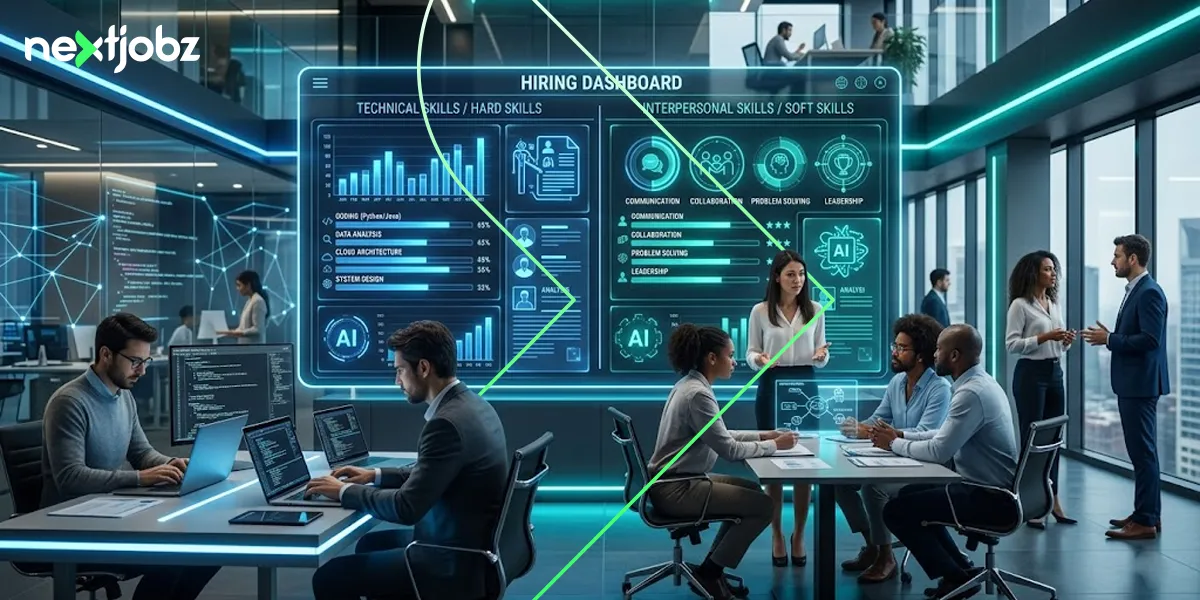
Every job requires two types of skills, and understanding the difference between soft skills vs hard skills can change how you approach your entire job search.
Hard skills are the specific technical abilities you learn through education, training, or experience. Soft skills are the personal and interpersonal abilities that shape how you work, communicate, and adapt. Both matter deeply in 2026.
A survey of 1,005 hiring managers by ResumeTemplates.com found that 62 percent say hard and soft skills are equally valuable, while 24 percent say soft skills will matter more going forward. LinkedIn data shows that 92 percent of hiring professionals believe soft skills are as important as, or even more important than, technical qualifications. And research by Harvard Business School found that 85 percent of long-term job success depends on soft skills.
So which one should you focus on? The honest answer is both. This guide breaks down exactly what each type of skill is, how they compare, what recruiters actually look for, and how job seekers in Bangladesh can build and present both to get hired faster.
What Are Soft Skills?
Soft skills are personal and interpersonal qualities that affect how you work, communicate, and get along with others. Unlike technical knowledge, soft skills are harder to teach in a classroom setting but are deeply valued by employers across industries.
Soft Skills Definition
Soft skills are non-technical abilities that describe how a person behaves, communicates, and interacts in a professional setting. They include things like communication, teamwork, empathy, adaptability, and time management.
Consider soft skills the part of you that is being a good worker, that is on the human side. Knowing everything about accounting or coding is great, but not communicating with your team, missing deadlines, and not being able to take criticism is not enough.
Soft skills are applicable in any job, in any field. They’re required for a marketing pro. So do a factory supervisor, a customer service representative, and a software developer. It is not only about what they can do, but also about how they do it, which is determined by them.
Soft Skills Examples
The most valued soft skills include communication, problem-solving, teamwork, adaptability, emotional intelligence, leadership, and time management. These are the skills that appear in almost every job description, even when they are not explicitly named.
Here are the most in-demand soft skills for 2026, according to a survey of 1,005 hiring managers by ResumeTemplates and reported by HR Dive:
| Soft Skill | Why It Matters at Work |
| Communication | Clear communication prevents misunderstandings and builds trust across teams |
| Professionalism | Shows reliability and sets the standard for how you represent yourself and your employer |
| Time management | Helps you meet deadlines and prioritize work without being told what to do next |
| Accountability | Employers value people who take ownership of their work and their mistakes |
| Resilience | The ability to recover from setbacks and stay productive under pressure |
| Problem solving | Shows that you can work through challenges independently and creatively |
| Critical thinking | Helps you analyze information and make sound decisions in complex situations |
| Attention to detail | Reduces errors and signals professionalism in every output you produce |
| Collaboration | Most modern workplaces require you to work effectively with others toward shared goals |
| Adaptability | In a fast-changing world, the ability to adjust and keep performing is essential |
Importance of Soft Skills in the Workplace
Soft skills are not extras. Research shows they drive the majority of long-term career success and are the leading reason candidates get rejected or hired at all levels.
The numbers make a strong case. According to Passive Secrets, which compiled 40 soft skills statistics from major studies, soft skills account for approximately 70-80% of the skills required for success in the workplace.
Technical hard skills account for only 20-30%. Even more striking, 85 percent of long-term job success is attributed to people skills, while technical ability accounts for just 15 percent.
Poor communication alone costs large companies an average of 62.4 million dollars per year. And according to LinkedIn’s Global Talent Trends report cited by WeCreateProblems, 89 percent of bad hires lack critical soft skills, regardless of how strong their technical background is.
In Bangladesh’s growing private sector, NGO topography, and multinational company environment, soft skills are equally critical.
Employers increasingly want candidates who can work in teams, adapt to new tools, communicate across departments, and handle the pressures of fast-moving work environments.
What Are Hard Skills?
Hard skills are specific, teachable abilities that you learn through education, training, or direct practice. They are the technical qualifications that make you eligible for a particular role and can usually be measured, tested, or certified.
Hard Skills Definition
Hard skills are measurable, role-specific abilities that a candidate acquires through formal education, professional training, or hands-on experience. They are directly tied to job tasks and vary significantly by industry and role level.
A fresh graduate in finance might list Excel, financial modeling, and accounting software as hard skills.
A software developer might list Python, JavaScript, and database management as their skills. A data analyst might list SQL, Tableau, and statistical analysis.
These are concrete, demonstrable skills that a recruiter can verify through a certificate, a portfolio, or a skills test.
Hard skills get your application past the first filter. Most Applicant Tracking Systems scan resumes for specific keywords related to technical tools and qualifications.
If your hard skills do not match the job description, your application may never reach a human recruiter.
Hard Skills Examples
Hard skills examples vary by industry but typically include technical tools, software programs, languages, certifications, and data-related abilities. Listing relevant hard skills is one of the most important things you can do on your resume.
| Industry / Field | Common Hard Skills |
| Technology | Python, Java, SQL, cybersecurity, cloud computing, network management |
| Marketing | Google Ads, SEO, Meta Ads, content strategy, Google Analytics, Canva |
| Finance and Accounting | Excel, financial modeling, tax compliance, ERP systems, IFRS standards |
| Human Resources | Recruitment software, payroll systems, labor law knowledge, HRIS tools |
| Operations and Supply Chain | Inventory management, procurement systems, logistics software, ERP |
| Healthcare | Medical record systems, clinical documentation, and diagnostic tool proficiency |
| Education and Training | Curriculum design, LMS platforms, instructional design, assessment tools |
| Data and Research | SPSS, R, Tableau, Power BI, data visualization, survey design |
Most In-Demand Hard Skills for 2026
The most in-demand hard skills for 2026 include software tools, data analysis, cybersecurity, project management, and AI literacy. Employers across all industries are prioritizing candidates who bring at least one of these technical competencies.
Based on the ResumeTemplates survey of 1,005 hiring managers as reported by HR Dive, the top hard skills employers want in 2026 are:
- Software tools relevant to the specific job function
- Data analysis and data-informed decision making
- Cybersecurity awareness and digital safety practices
- Project management and workflow coordination
- Quality assurance and testing
- Automation and workflow optimization
- Technical writing and documentation
- Data visualization using tools like Tableau or Power BI
- AI tools and basic AI literacy
For job seekers in Bangladesh, the most practical hard skills to build right now are Excel and data tools, digital marketing and SEO, accounting and ERP software, programming basics such as Python, and any platform-specific certification that matches your target industry.
Soft Skills vs Hard Skills: Key Differences
The core difference between soft skills and hard skills is that hard skills are what you know how to do technically, while soft skills are how you do it. Both are necessary, but they serve different purposes in the hiring process and in the workplace.
Comparison Table
This table breaks down the key differences between soft skills and hard skills so you can clearly see how each type functions in the real world of work and hiring.
| Feature | Soft Skills | Hard Skills |
| What they are | Personal and interpersonal traits and behaviors | Specific technical knowledge and abilities |
| How do you learn them | Through experience, reflection, and practice | Through education, training, and certification |
| Can they be measured? | Harder to measure directly | Easily tested and verified |
| Do they change by industry? | Largely the same across all industries | Highly specific to each role and sector |
| How long to develop? | Takes time and real-world experience | Can be learned relatively quickly with focused training |
| How recruiters assess them | Behavioral interview questions, references, and group exercises | Skills tests, certifications, portfolio, and technical interviews |
| ATS impact | Harder to detect in automated screening | Directly matched by keyword scanning systems |
| Examples | Communication, leadership, adaptability | Python, Excel, financial reporting, SEO |
Why Soft Skills Matter More Than Ever
As automation and AI take over routine tasks, the skills that remain distinctly human are becoming the most valuable of all. Soft skills are precisely the human capabilities that machines cannot replicate, which is why employers treat them as a competitive advantage.
Why Soft Skills Matter More Than Hard Skills
Soft skills matter more than hard skills in the long run because they determine how you grow, collaborate, lead, and adapt. Technical skills can be taught. The ability to communicate clearly, manage your emotions under pressure, and work effectively with others is much harder to build in a training session.
According to LinkedIn’s 2026 Skills on the Rise report, cited by Caprel, 57 percent of senior leaders value soft skills over hard skills.
And a LinkedIn survey found that 92 percent of hiring professionals believe soft skills are equally or more important than technical qualifications when evaluating candidates for roles at all levels.
Most hard skills can be trained relatively quickly. If a new hire does not know a specific software, they can learn it within weeks.
But if a new hire cannot communicate clearly, take feedback constructively, or work under pressure without becoming difficult, those problems are far harder to fix and far more costly to the team.
In 2026, as AI handles increasing amounts of technical work, the human skills of judgment, creativity, collaboration, and ethical reasoning are becoming the real differentiators between candidates.
Employers are not looking for people who can do tasks. They are looking for people who can think, adapt, and lead.
What Recruiters Really Look For in Candidates
Recruiters evaluate candidates on both types of skills, but the weight they give to each depends on the role, the company culture, and the position’s level. Understanding what a recruiter actually looks for helps you present yourself in exactly the right way.
What Hiring Managers Look for in Candidates
Hiring managers are looking for candidates who have the technical ability to do the job, the interpersonal skills to do it with others, and the mindset to keep growing. In 2026, no single skill type wins on its own.
Based on data from the ResumeTemplates.com hiring manager survey of 1,005 professionals, hiring managers in 2026 say they want candidates who demonstrate a balance of hard skills for specific job functions and soft skills for working effectively within a team.
In a separate finding, 65 percent of employers now evaluate candidates primarily based on specific competencies rather than just degrees or job titles, according to The Interview Guys.
Here is what recruiters actually pay attention to during the hiring process
- Your ability to communicate your experience clearly in writing and in person
- Evidence that you have delivered results, not just performed duties
- Specific technical skills that match the requirements in the job description
- Signs that you can work with a team and handle workplace challenges
- Whether your attitude and work style match the company culture
- How quickly can you learn new tools or adapt to new processes
Key Skills Recruiters Look for in Resumes
On a resume, recruiters look for a balance of relevant hard skills listed clearly in the skills section and soft skills demonstrated through real examples in the experience section.
Listing soft skills like teamwork without any supporting evidence is the most common mistake job seekers make.
According to Jobscan’s State of the Job Search report, 54 percent of recruiters value personalized applications that highlight unique value, and 58 percent are specifically impressed by measurable achievements.
It means your resume should not just say you have good communication skills. It should illustrate a specific situation in which your communication made a real difference.
The most effective approach is to list your hard skills in a dedicated skills section, then demonstrate your soft skills through achievement-focused bullet points in your experience section.
Top Soft Skills for Job Seekers in 2026
The soft skills that give job seekers the biggest advantage in 2026 are the ones that directly address how modern workplaces operate: fast-paced, collaborative, increasingly digital, and frequently uncertain.
| Soft Skill | Why It Matters in 2026 |
| Communication | Ranked as the number one soft skill by hiring managers. Clear communication is essential in remote, hybrid, and in-person settings alike |
| Adaptability | With AI and market conditions changing constantly, employers prioritize people who can shift and perform in new situations |
| Critical thinking | The ability to analyze information and make sound decisions is increasingly valued as AI handles routine processing |
| Emotional intelligence | Understanding and managing your own emotions while reading others is a key predictor of leadership success |
| Collaboration | Cross-functional teamwork is now standard in most organizations. The ability to work well with people from different backgrounds and departments is essential |
| Accountability | Employers want people who take ownership of their results without needing to be managed closely |
| Resilience | The ability to stay productive and professional when things go wrong is one of the most sought-after traits at every level |
| Problem solving | Identifying root causes and proposing practical solutions is valued in every industry and at every seniority level |
Hard Skills Employers Look For in 2026
Hard skills are the technical entry point for most roles. Without them, your application may not even reach a human recruiter. In 2026, employers increasingly expect candidates to have a combination of role-specific technical skills and broader digital literacy.
Across industries, the hard skills that consistently appear in job descriptions and hiring manager surveys include
- Data analysis using tools like Excel, Power BI, or Tableau
- Digital marketing skills, including SEO, Meta Ads, and Google Ads
- Programming languages, including Python, JavaScript, and SQL for tech-adjacent roles
- Project management using tools like Trello, Asana, or MS Project
- AI tool literacy, including the ability to use productivity and automation tools
- Financial reporting, accounting software, and ERP systems for business roles
- Content creation and technical writing for communication-focused positions
- Cybersecurity awareness for any role involving data or digital systems
For fresh graduates in Bangladesh, building even one or two of these hard skills through online certifications, bootcamps, or self-directed practice can significantly improve your employability.
Platforms like Coursera, Google, and HubSpot Academy offer free or low-cost certifications recognized by employers worldwide.
How to Balance Soft and Hard Skills
The most hireable candidates in 2026 are not the ones with the most hard skills or the best soft skills. They are the ones who have the right balance of both, presented in a way that clearly shows they can do the job and work well with others.
Ideal Skill Mix for Career Success
A well-rounded candidate brings technical competence in the areas most relevant to their role, combined with the interpersonal and behavioral strengths that allow them to apply that competence effectively in a team environment.
Here is a simple way to think about the ideal skill mix by career stage
| Career Stage | Hard Skills Focus | Soft Skills Focus |
| Fresh graduate | Build 2 to 3 specific technical skills relevant to your target industry | Communication, teamwork, time management, and willingness to learn |
| Junior professional | Deepen existing skills and add 1 to 2 new technical tools | Accountability, problem solving, adaptability, and cross-functional collaboration |
| Mid-career professional | Maintain technical relevance and pursue advanced certifications | Leadership, emotional intelligence, strategic thinking, and mentoring others |
| Senior professional | Stay current with emerging tools and industry developments | Influence, organizational judgment, stakeholder management, resilience |
Skills Needed to Get Hired Faster
Job seekers who get hired quickly are those who match their listed skills directly to the job description, demonstrate how they have applied those skills, and present both technical and interpersonal capabilities.
Practical steps to get hired faster using your skill set
- Read the job description carefully and identify the top three required skills
- Match your hard skills to those requirements using the same language the job posting uses
- For each soft skill you claim, write a specific example of when you demonstrated it
- Put your hardest and most relevant technical skills in a dedicated skills section at the top of your resume
- In your cover letter, open with your strongest achievement and connect it to the role
- In interviews, use the STAR method: Situation, Task, Action, Result for every skill claim
If you want more guidance on how to present your skills in a job interview, you’d better learn to prepare for job interviews in Bangladesh, which is a practical next read.
How to Showcase Skills on Your Resume
The most effective resume does two things well. It lists hard skills clearly so ATS systems can find them, and it demonstrates soft skills through specific achievements so human recruiters can believe them. Listing soft skills without evidence is one of the most common resume mistakes.
Soft Skills in Resume Examples
Please do not list a soft skill and leave it there. Every soft skill on your resume should be backed by a brief example that shows when and how you used it. This is what separates a memorable resume from one that reads like a template.
Here are examples of how to show soft skills on a resume through real experience bullets
| Weak Version | Strong Version |
| Good communication skills | Presented monthly performance reports to a 15-person management team and answered questions in real time |
| Strong leadership | Led a team of 6 people through a product launch, delivering the project two weeks ahead of schedule |
| Problem solver | Identified a recurring billing error that was affecting 12 percent of customer accounts and proposed a fix that reduced complaints by 40 percent |
| Team player | Collaborated with four departments to coordinate a company-wide policy rollout affecting 200 employees |
| Adaptable | Transitioned the team to remote work in two weeks during an office relocation with zero disruption to project timelines |
Hard Skills List for Resume
Hard skills should be listed clearly in a dedicated skills section, organized by category if you have many. Use the exact terminology from the job description to improve your match rate with ATS systems.
Examples of how to format hard skills by category on a resume
- Software and Tools: Microsoft Excel, Power BI, Google Analytics, Canva, Slack
- Programming: Python, SQL, HTML, JavaScript
- Marketing: SEO, Meta Ads Manager, Google Ads, HubSpot, email marketing
- Finance: Financial reporting, QuickBooks, IFRS standards, payroll software
- Project Management: Asana, Trello, Jira, Agile, Scrum methodology
- Languages: Bangla (native), English (professional proficiency), Hindi (conversational)
Employability Skills for Fresh Graduates
Fresh graduates in Bangladesh often underestimate what they already have. Academic projects, internships, volunteer work, and even part-time jobs build real and demonstrable skills.
The key is knowing how to recognize and present them.
As a new graduate, you are about to start looking for jobs. Here are the skills that will provide you with the best foundation.
- Communication: Being able to communicate clearly and confidently, and to listen actively, is respected from the start.
- Flexibility: Let employers know you are learning. The ability to quickly adjust and take feedback in stride is more important than knowing all the answers.
- Basic digital tools: Using and creating with Excel, Google Docs, and presentation software, and communicating via email are expected in nearly every white-collar job.
- Any relevant hard skill: One certification or evidence of a relevant tool skill will help you.
- Professionalism: Punctuality, reliability, and a positive attitude towards the workplace are soft skills valued by employers in entry-level positions.
Platforms like nextjobz are designed to help fresh graduates in Bangladesh find entry-level roles and career resources that match their developing skill set.
If you are still building your portfolio, use that time to earn free certifications, contribute to projects, and develop the technical and soft skills that your target employers ask for most.
How to Improve Your Skills
Improving your skills does not require going back to school. In 2026, the most practical skill development happens through online courses, real-world projects, mentorship, and deliberate daily practice.
How to Improve Soft Skills for Career Growth
Improving soft skills is an ongoing process. The most effective approach combines self-awareness with deliberate practice and regular feedback from colleagues.
Here are practical ways to develop your soft skills
- Ask for feedback from a manager, colleague, or mentor at least once every three months
- Join a team project or committee outside your usual responsibilities to practice collaboration and leadership
- Practice public speaking through team meetings, presentations, or groups like Toastmasters
- Read widely about emotional intelligence, communication, and professional behavior, and try applying one new idea per week
- Reflect after difficult situations at work by asking yourself what you could have communicated or handled better
- Seek out roles and tasks that feel slightly uncomfortable, as growth usually happens outside your comfort zone
How to Develop Hard Skills Quickly
Hard skills can be built quickly with the right resources and focused practice. In most cases, a combination of free online learning, applied projects, and a recognized certification is enough to add a credible new skill to your resume within one to three months.
Practical steps to build hard skills fast
- Identify the top two or three hard skills that appear most often in job descriptions for your target role
- Find a free or low-cost course on Google Career Certificates, Coursera, Udemy, LinkedIn Learning, or HubSpot Academy
- Complete at least one real project using the skill, even a self-initiated one, so you have something concrete to show
- Earn a shareable certificate and add it to your LinkedIn profile and resume
- Practice the skill weekly so it stays fresh and deepens over time
Future Skills in Demand for Jobs
The job market is changing faster than ever. The skills that are most in demand in 2026 and beyond combine human judgment with digital fluency. Candidates who build these future-ready skills now will have a significant advantage for years to come.
The most forward-looking skills include:
- AI literacy and prompt engineering: The ability to use AI tools effectively across work functions is becoming a baseline expectation, not a specialty
- Data storytelling: Reading data is not enough. The ability to turn data into a clear narrative that drives decisions is increasingly valued
- Emotional and social intelligence: As AI handles more cognitive tasks, purely human skills like empathy, nuanced communication, and relationship management become differentiators
- Continuous learning mindset: Employers are prioritizing candidates who show they can adapt to new tools and knowledge over time, not just those who already have them
- Cross-functional collaboration: In flatter organizational structures, the ability to work across departments and disciplines is a career-defining skill
- Cybersecurity awareness: Basic digital safety knowledge is now expected across roles, not just in IT
The Authority Summary
Soft skills and hard skills are not competing with each other. They are complementary. One gets you in the door. The other keeps you growing once you are inside. The most successful job seekers understand both and deliberately build both.
If you are a fresh graduate in Bangladesh, start by identifying the two or three hard skills most relevant to your target industry and begin building them immediately through free courses and practical projects.
At the same time, pay attention to how you communicate, work with others, and handle challenges. These soft skills will compound over time into one of your most powerful career assets.
The job market in 2026 rewards people who combine technical competence with human ability. Employers are not looking for a perfect hard skills list or a flawless personality. They are looking for people who can do the work and grow with the team.
Understanding the difference between soft skills and hard skills is the starting point. Knowing how to develop and present them is what actually gets you hired.
If you are ready to start putting your skills to work, explore the job opportunities and career tools available on NextJobz, designed specifically for job seekers navigating the Bangladeshi job market.
Frequently Asked Questions on Soft Skills Vs Hard Skills
What is the difference between soft skills and hard skills?
Hard skills are specific, teachable technical abilities, such as coding or data analysis. Soft skills are personal traits, such as communication and adaptability, that shape how you work with others.
Which is more important: soft skills or hard skills?
Both are essential. Hard skills get your application noticed. Soft skills determine your long-term success. Research shows 62 percent of hiring managers say both are equally valuable.
Can you get a job without soft skills?
You may be hired, but you will likely struggle to grow. LinkedIn data shows that 89 percent of bad hires lack critical soft skills, even when they have strong technical qualifications.
How do recruiters evaluate skills?
Recruiters assess hard skills through tests, certifications, and portfolio reviews. They evaluate soft skills through behavioral interview questions, references, and group exercises during the hiring process.
What skills are most important in 2026?
Communication tops the soft skills list. Software tools and data analysis top the hard skills list. AI literacy and adaptability are the fastest-growing skills employers now expect across roles.